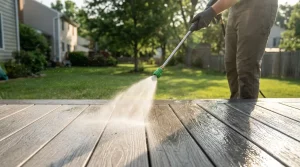

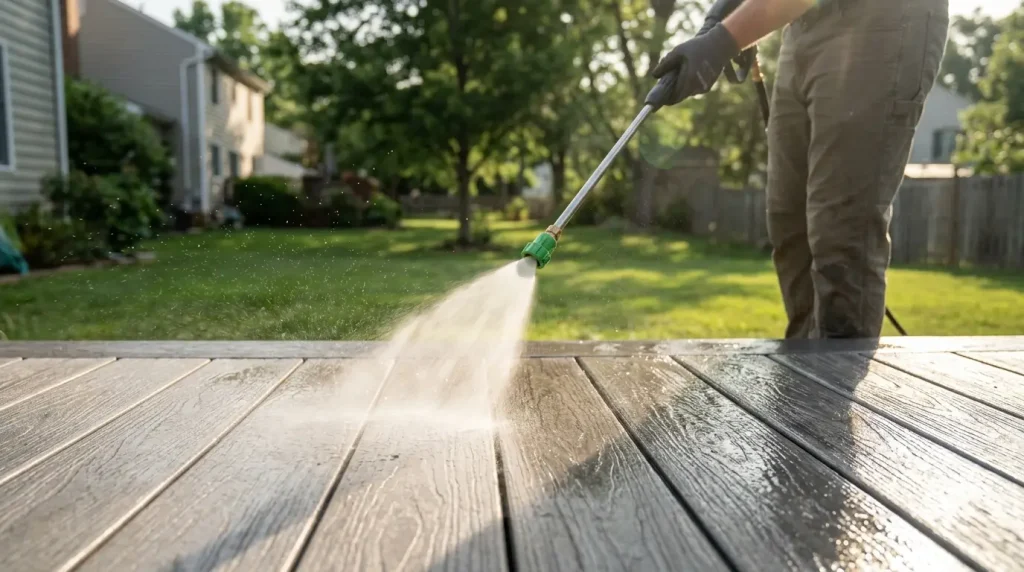
Yes, some composite decking can be pressure washed, but whether you should use a pressure washer depends on the exact decking brand, product line, age, and condition.
Composite decking may look strong enough to handle the same cleaning pressure used on concrete, but excessive pressure can damage the surface. It can leave visible lines, dull the finish, change the texture, or affect the protective outer layer on some boards.
The safest approach to deck cleaning is not to choose a random pressure setting. The correct approach is to identify the decking material, check the manufacturers cleaning instructions, and use the least aggressive method needed to remove dirt and buildup.
For many composite decks, a suitable cleaner, gentle brushing, and controlled rinsing can do most of the work.
This guide explains when composite decking can be pressure washed, how pressure limits vary by brand, how to clean composite decking safely, and what mistakes to avoid.
Can You Pressure Wash Composite Decking
Yes, but every composite deck should not be cleaned the same way.
Different manufacturers provide different pressure washing instructions.
Trex allows pressure washing on some current product lines under specific conditions. TimberTech recommends much lower pressure and treats the power washer mainly as a rinsing tool. MoistureShield and Fiberon also publish their own limits and cleaning methods.
This means homeowners should not follow one universal pressure setting for every composite deck.
The most important rule is simple.
Always follow the cleaning instructions for the exact decking product installed on your property.
Why Composite Decking Needs a Different Cleaning Method
Composite decking is not the same as concrete and it is not cleaned exactly like natural wood.
Many composite boards contain a combination of wood fibers, plastics, polymers, mineral materials, or other engineered components.
Modern composite decking often includes a protective outer layer called a cap.
This surface can help resist stains, moisture, fading, and everyday wear.
However, the visible surface can still be damaged by concentrated water pressure.
Good composite deck cleaning depends on the correct cleaner, proper contact time, appropriate brushing, controlled water pressure, correct nozzle selection, safe working distance, and manufacturer instructions.
The goal is to remove contamination from the surface without damaging the material itself.
Capped and Uncapped Composite Decking
Understanding whether your deck is capped or uncapped can help determine how carefully it should be cleaned.
Capped Composite Decking
Most newer composite decking products include a protective surface layer.
This outer layer helps resist stains, fading, moisture, and wear.
Because this layer forms the visible finish of the deck, aggressive pressure washing can affect its appearance.
If a stain does not come off easily, the solution is usually not to increase pressure.
It is better to identify the type of stain and use the correct cleaning method.
Older and Uncapped Composite Decking
Older composite decking may not have the same protective outer layer found on newer boards.
This means older products may react differently to pressure washing and cleaning chemicals.
Some current Trex product lines can be pressure washed under approved conditions.
However, Trex does not recommend pressure washing several early generation products.
If you have an older deck and do not know the exact product, start with a gentler cleaning method.
Use water, a suitable cleaner, and a soft brush before considering a pressure washer.
What Pressure Should You Use on Composite Decking
There is no single pressure setting that is safe for every composite deck.
This is one of the most important things to understand before cleaning.
Some websites recommend one pressure limit for every composite product.
That advice can be misleading because manufacturers publish different limits.
Trex
Trex allows certain current product lines to be pressure washed with a fan tip and proper working distance.
The company allows higher pressure than some other manufacturers.
However, those instructions do not apply to every older Trex product.
TimberTech
TimberTech recommends a more conservative cleaning approach.
Its instructions allow a power washer mainly for rinsing and recommend lower pressure than Trex.
The company also recommends spraying in the direction of the board grain.
MoistureShield
MoistureShield recommends lower pressure and a safe working distance between the nozzle and the surface.
The company warns that excessive pressure can permanently damage the decking.
Fiberon
Fiberon also advises caution when using a pressure washer.
Its maintenance guidance recommends keeping the nozzle at a safe distance and cleaning in the direction of the grain pattern.
The main lesson is simple.
Do not ask what pressure is safe for composite decking in general.
Ask what pressure and cleaning method the manufacturer recommends for your exact product.
Can High Pressure Damage Composite Decking
Yes.
Composite decking is durable, but that does not mean the surface cannot be damaged.
Improper pressure washing can cause visible wand marks, uneven cleaning lines, surface dulling, changes in texture, damage to the protective surface, discoloration, roughened areas, and damage around board edges.
Some pressure washing damage becomes more visible after the deck dries.
A wet surface can temporarily hide texture changes and color differences.
Once the deck dries, streaks and marks may become easier to see.
This is why testing a small hidden area first is always a good idea.
How to Pressure Wash Composite Decking Safely
A careful cleaning process reduces the risk of surface damage.
Identify the Decking Brand
Before cleaning, determine what material is installed.
Check installation records, builder information, product labels, receipts, warranty documents, or markings on the boards.
Knowing that the deck is composite is not enough.
Different product lines from the same manufacturer may have different cleaning instructions.
Read the Current Care Guide
Always check the manufacturers latest cleaning instructions.
Look for information about pressure limits, nozzle type, working distance, approved cleaners, brush type, and warranty conditions.
Do not copy settings from another brand just because the boards look similar.
Remove Furniture and Outdoor Items
Clear the deck before cleaning.
Move furniture, planters, grills, rugs, toys, and decorative items.
This makes the deck easier to clean and allows you to inspect hidden areas.
It also helps you find stains that may have developed under furniture or outdoor rugs.
Sweep the Deck
Remove leaves, pollen, soil, sticks, and other loose debris.
Pay special attention to the spaces between boards.
Debris trapped between boards can affect drainage and keep the deck damp for longer periods.
Pre Rinse the Surface
Use a garden hose to remove loose dirt.
This gives you a better view of the stains and buildup that still need attention.
You may notice algae, grease, food stains, mud, leaf marks, or other contamination.
Do not start with maximum pressure.
Apply the Correct Cleaner
Effective deck cleaning starts with the right cleaner.
The cleaner should loosen dirt and organic buildup so the pressure washer does not have to do all the work.
Depending on the manufacturer, the recommended cleaner may be warm soapy water or a specific decking cleaner.
Trex often recommends warm soapy water and a soft brush for general dirt.
TimberTech recommends specific cleaners for its current products.
This shows why a cleaner that works well on one composite brand may not be the best choice for another.
Let the Cleaner Work
Cleaning products need enough time to loosen contamination.
However, the cleaner should not be allowed to dry on the surface.
Work in smaller sections so you can apply the cleaner, scrub if needed, and rinse before the product dries.
Use the Correct Brush
A suitable brush can often remove dirt more safely than increasing water pressure.
Use the brush type recommended by the decking manufacturer.
A brush that is too stiff can scratch or dull some composite finishes.
Use a Fan Tip
If pressure washing is approved, use a wide fan spray.
A fan pattern spreads the water force over a larger area.
Avoid concentrated spray patterns that focus too much pressure in one spot.
Maintain Safe Distance
Working distance matters.
The closer the nozzle is to the deck, the stronger the water force becomes.
Always follow the minimum distance recommended by the manufacturer.
Starting farther away is safer than starting too close.
Keep the Wand Moving
Never hold the water stream in one place.
Move the wand smoothly and consistently across the deck.
Do not stop over stubborn stains.
If a stain does not respond, use a more suitable cleaner instead of moving the nozzle closer.
Follow the Direction of the Boards
When recommended by the manufacturer, clean and rinse in the same direction as the board pattern.
This can help reduce visible marks and uneven cleaning.
Rinse Thoroughly
Remove all cleaning solution and dirty water from the surface.
Soap and dirty rinse water can leave a film if they are allowed to dry.
Take time to rinse each section carefully.
What If You Do Not Know the Composite Decking Brand
This is a common situation.
You may have purchased a home with an existing deck and have no idea which product was installed.
If you cannot identify the manufacturer, do not assume that pressure washing is safe.
Start with a gentler approach.
Use a garden hose.
Use a mild cleaner.
Use a soft brush.
Test the cleaner in a hidden area.
Avoid aggressive pressure washing.
An older composite product may be more sensitive than a newer capped deck.
When the exact material is unknown, a conservative cleaning method is usually the safer choice.
Is Soft Washing Better Than Pressure Washing Composite Decking
The answer depends on the deck and the cleaning solution being used.
The main principle is that the cleaner should do more of the work than the water pressure.
Composite decking usually does not need aggressive pressure for normal dirt, pollen, algae, or surface grime.
A professional cleaning process may use a suitable cleaner, controlled application, gentle brushing, and low pressure rinsing.
This reduces the chance of surface damage.
However, not every chemical used for exterior cleaning is suitable for every composite deck.
Always check chemical compatibility with the decking manufacturer.
Can You Use Bleach on Composite Decking
Do not assume household bleach is safe for every composite product.
Manufacturers provide different recommendations.
Some cleaners can change the appearance of the decking.
A strong chemical may lighten or dull the surface.
The safest option is to use a cleaner approved for the exact decking product.
If you are unsure, test the cleaner on a small hidden area before using it across the entire deck.
How to Remove Mold Mildew and Algae From Composite Decking
Composite decking can still develop organic buildup.
Pollen, dirt, leaves, food residue, soil, and tree debris can collect on the surface.
When this material stays damp, algae, mold, or mildew may develop.
A safer cleaning process includes removing loose debris, rinsing the surface, applying an approved cleaner, allowing enough contact time, brushing gently if recommended, and rinsing thoroughly.
Do not try to remove green buildup by simply increasing pressure.
The correct cleaner is usually more important than stronger water pressure.
How to Remove Food and Grease Stains From Composite Decking
Composite decks are often located near grills and outdoor dining areas.
Food and grease stains should be treated quickly.
Fresh stains are usually easier to remove.
Remove excess material first.
Check the manufacturers cleaning instructions.
Apply the recommended cleaner.
Treat the affected area.
Rinse thoroughly.
A stubborn stain does not mean you need more pressure.
Correct stain treatment is more important.
Can You Use a Surface Cleaner on Composite Decking
Surface cleaning attachments are commonly used on concrete.
Composite decking is different.
A surface cleaner uses rotating high pressure jets at a fixed distance from the surface.
This can reduce the operators ability to adjust pressure and distance quickly.
Unless the decking manufacturer clearly approves the equipment and cleaning settings, a surface cleaner should not automatically be used on composite decking.
A controlled fan spray provides more direct control.
Can You Use a Turbo Nozzle on Composite Decking
Turbo nozzles produce a powerful concentrated spray.
They can be useful on certain hard surfaces.
However, they are generally too aggressive for finished composite decking unless the manufacturer specifically approves their use.
A wide fan spray is usually the safer option.
Common Composite Deck Cleaning Mistakes
Treating Composite Decking Like Concrete
Concrete may tolerate stronger pressure.
Composite decking should not automatically be cleaned with the same settings.
Using One Pressure Setting for Every Deck
Different manufacturers publish different pressure limits.
There is no universal setting for all composite decking.
Holding the Nozzle Too Close
The closer the nozzle gets to the deck, the stronger the water force becomes.
This increases the risk of damage.
Using Pressure Instead of Cleaner
If the deck is still dirty, better cleaning chemistry may be needed.
More pressure is not always the answer.
Using the Wrong Cleaner
Different decking brands may require different cleaners.
Always check product compatibility.
Letting Cleaner Dry
Cleaner that dries on the surface may leave residue or visible film.
Work in smaller sections.
Ignoring the Age of the Deck
Older composite products may be more sensitive than newer capped products.
Failing to Test First
Always test your cleaner and cleaning method in a hidden area before treating the entire deck.
How Often Should Composite Decking Be Cleaned
Cleaning frequency depends on the conditions around the deck.
A deck may need more frequent cleaning if it is located under trees, receives little sunlight, stays damp after rain, collects heavy pollen, or develops recurring algae.
A practical approach is to inspect the deck during spring and fall.
Cleaning the surface before heavy buildup develops is easier and safer than waiting until the deck becomes heavily stained.
Signs Your Composite Deck Needs Cleaning
A composite deck may need cleaning when you notice green areas, dark stains, visible pollen, mud, greasy spots, slippery buildup, dirt trapped in the board texture, debris between boards, or an uneven appearance caused by grime.
Regular cleaning can help maintain the decks appearance and prevent buildup from becoming harder to remove.
Signs of Pressure Washing Damage
Pressure washing damage may appear as light or dark cleaning lines, rough patches, dull areas, texture changes, uneven surface shine, visible striping, or damaged edges.
If pressure washing appears to have changed the physical surface, stop cleaning.
More pressure will not fix the problem.
Contact the decking manufacturer or a qualified professional before attempting another cleaning method.
Is Professional Composite Deck Cleaning Worth It
Cleaning the deck yourself may be reasonable if you know the exact decking brand, understand the manufacturers instructions, and have experience using a pressure washer.
Professional cleaning can make more sense when the decking brand is unknown, the deck is older, there is heavy algae buildup, there are several different stains, or you are unsure which cleaning products are safe.
Composite decking can be expensive to replace.
Using the correct cleaning method can help reduce the risk of unnecessary surface damage.
Composite Deck Cleaning in Richmond Virginia
Outdoor surfaces in Richmond can collect pollen, dirt, leaves, and organic buildup throughout the year.
Composite decking requires less maintenance than many traditional wood decks, but it still needs periodic cleaning.
Jacobsons Power Washing adjusts the cleaning method based on the decks material, age, condition, and manufacturer guidance.
Instead of using the same pressure on every deck, the cleaning process should match the surface being treated.
This is especially important for composite decking because different brands can have very different cleaning requirements.
Professional deck cleaning can help remove dirt, algae, pollen, and surface buildup while reducing the risk of damage caused by excessive pressure.
Frequently Asked Questions
Can Composite Decking Be Pressure Washed
Yes, some composite decking can be pressure washed.
The correct pressure, nozzle, working distance, and cleaning method depend on the exact manufacturer and product line.
Always check the manufacturers care instructions before using a pressure washer.
Can Trex Decking Be Pressure Washed
Some current Trex decking products can be pressure washed under approved conditions.
Older Trex products may have different instructions.
Always identify the exact product before cleaning.
What Pressure Should I Use on Composite Decking
There is no universal pressure setting for every composite deck.
Different manufacturers publish different limits.
Use the instructions provided for your exact decking product.
Can TimberTech Be Pressure Washed
TimberTech allows pressure washing under specific conditions and recommends a conservative approach.
The power washer is mainly used for rinsing.
Follow the current manufacturer instructions before cleaning.
Can Pressure Washing Ruin Composite Decking
Yes.
Excessive pressure, a narrow spray pattern, poor working distance, or holding the nozzle in one place can damage the surface.
Is It Better to Pressure Wash or Scrub Composite Decking
For normal dirt and surface buildup, a suitable cleaner and gentle brushing are often more important than high pressure.
Pressure washing should only be used when the manufacturer allows it.
How Often Should Composite Decking Be Cleaned
Cleaning frequency depends on shade, moisture, pollen, tree cover, and use.
Checking the deck in spring and fall is a practical approach for many homeowners.
Can I Clean Composite Decking With Soap and Water
In many cases, soap and water can remove normal dirt.
However, some manufacturers recommend specific cleaners.
Check the care instructions for your decking before choosing a product.
Final Thoughts
Can composite decking be pressure washed
Yes, but the correct cleaning method depends on the exact decking product.
There is no single pressure setting that works safely for every composite deck.
The safest approach is to identify the product, review the manufacturers cleaning instructions, remove loose debris, apply the correct cleaner, brush gently when needed, use a wide spray pattern, maintain a safe working distance, and rinse thoroughly.
More pressure does not always mean better cleaning.
A good deck cleaning process removes dirt and organic buildup while protecting the finish of the decking.
If you need professional deck cleaning in Richmond Virginia, Jacobsons Power Washing can clean composite and wood decking using a method selected for the material and condition of the surface.
Contact Jacobsons Power Washing to request a free quote for professional deck and fence cleaning in Richmond Virginia and surrounding areas.