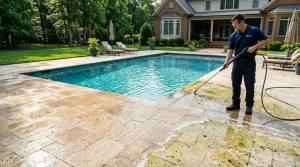

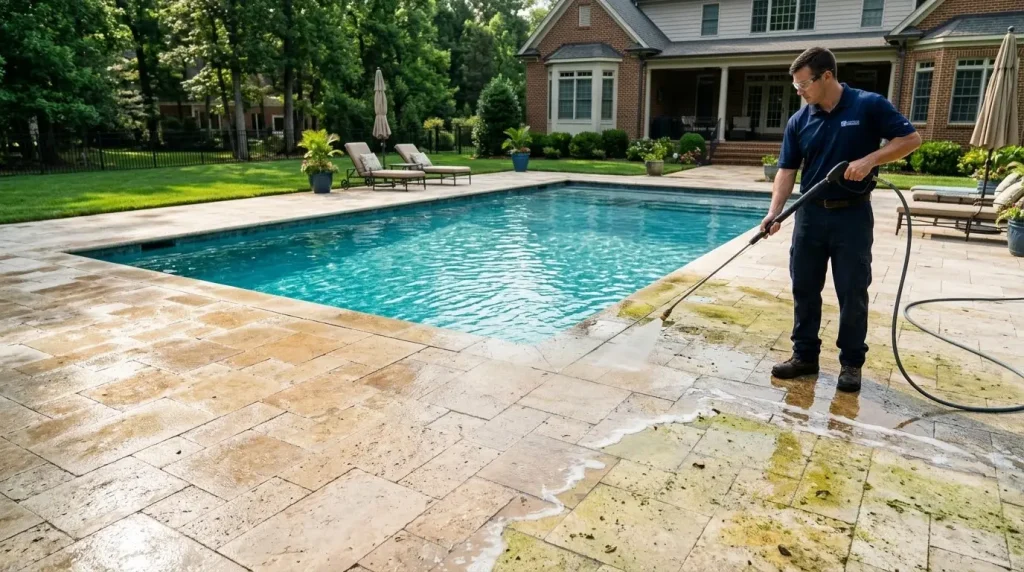
Pool decks collect much more than ordinary outdoor dirt. Water splash, sunscreen, body oils, pollen, leaves, algae, food spills, rust, mineral deposits, and daily foot traffic can all leave the surface looking stained, dull, or slippery.
Cleaning a pool deck may seem simple until you consider how many different materials are used around swimming pools.
Plain concrete can tolerate a cleaning method that may damage stamped concrete. A pressure setting that works on sound concrete can remove joint sand from pavers. An acidic cleaner that works on one masonry surface can permanently etch travertine or limestone.
This is why safe pool deck cleaning starts with identifying the surface before choosing a cleaner or pressure setting.
The best cleaning method removes dirt and biological buildup while protecting the texture, color, coating, joints, and surrounding pool water.
This guide explains how to clean a pool deck safely and how the cleaning method should change for concrete, pavers, porcelain, travertine, natural stone, painted surfaces, and decorative pool deck coatings.
Quick Answer
The safest way to clean a pool deck is to identify the surface first, sweep away loose debris, protect the pool and nearby landscaping, apply a cleaner that is compatible with the material, allow enough contact time, gently agitate stubborn areas, and rinse thoroughly.
Plain uncoated concrete can usually tolerate controlled pressure washing.
Stamped, colored, sealed, painted, and coated concrete should be cleaned more gently because the finish may be more vulnerable than the concrete underneath.
Pavers require controlled pressure so joint sand is not washed away.
Travertine and limestone should be cleaned with neutral or stone safe products because acidic cleaners can damage calcium based stone.
Kool Deck and similar decorative overlays should not automatically be treated like bare concrete.
If you do not know what material you have, start with the gentlest cleaning method instead of assuming the deck can handle strong pressure.
Why Pool Deck Cleaning Requires Extra Care
A pool deck experiences conditions that ordinary patios and walkways may not.
The surface is repeatedly exposed to water. Chlorinated or salt water may splash onto the deck. Bare feet leave body oils and sunscreen behind. Outdoor furniture can create rust or dark stains. Leaves may sit on wet surfaces and create tannin discoloration. Shade and humidity can encourage algae.
Cleaning chemicals also have to be controlled carefully because the deck surrounds a swimming pool.
A good pool deck cleaning process should therefore do more than make the surface look brighter. It should also protect surface texture, traction, decorative coatings, paver joints, nearby landscaping, and pool water.
Identify Your Pool Deck Material Before Cleaning
This is the most important step in the entire cleaning process.
Do not choose a pressure washer setting until you know what type of pool deck you are cleaning.
Several pool deck materials can look similar from a distance but react very differently to water pressure and cleaning chemicals.
Plain Concrete
Plain concrete is one of the most durable pool deck materials.
It can usually tolerate controlled pressure washing when the concrete is fully cured and in good condition.
However, concrete can still be etched by excessive pressure or poor technique. Older concrete, cracked areas, weak surface paste, and previously repaired sections require more caution.
Stamped Concrete
Stamped concrete is decorative concrete formed to resemble stone, brick, or other materials.
The concrete underneath may be strong, but the visible color and sealer are often more vulnerable.
Aggressive pressure can strip sealer, create uneven color, or leave visible cleaning lines.
Stamped concrete usually benefits from a cleaner first and lower pressure approach.
Colored or Stained Concrete
Decorative color may be mixed into the concrete or applied as a surface treatment.
The cleaning process should protect the color as well as remove dirt.
Strong chemicals and excessive pressure can cause uneven fading on some surfaces.
Always test the cleaning method in a small area first.
Sealed Concrete
Sealed concrete requires additional caution because the sealer can be damaged before the concrete itself.
A pressure washer may remove sections of failing sealer and create blotchy areas.
If the deck looks glossy or water beads strongly on the surface, determine whether a coating or sealer is present before cleaning aggressively.
Concrete Pavers
Pavers are durable, but the joints between them are a common weak point.
Excessive pressure can wash out regular sand or damage polymeric joint material.
A direct pressure washer stream should not be aimed into the joints.
Controlled cleaning and a wide fan spray are safer.
Porcelain Pavers
Porcelain pavers are dense and generally resistant to staining, but manufacturer instructions still matter.
Some manufacturers publish specific pressure limits for individual products.
The paver surface may tolerate washing well while the joint material remains vulnerable.
Protecting the joints is just as important as protecting the paver itself.
Travertine
Travertine is a natural calcium based stone.
It is porous and sensitive to acidic cleaning products.
Vinegar and many acidic masonry cleaners can permanently alter the surface.
A neutral or stone safe cleaner is the better starting point.
Limestone
Limestone is also calcium based and sensitive to acids.
It should be treated as natural stone rather than ordinary concrete.
Use mild cleaning products designed for stone.
Other Natural Stone
Slate, granite, flagstone, and other natural stone materials can have different chemical and pressure tolerances.
If the exact stone is unknown, begin with a neutral cleaner and gentle rinse until the material has been identified.
Kool Deck and Similar Pool Deck Coatings
Kool Deck and similar textured pool deck surfaces are overlays installed over concrete.
They should not automatically be treated like bare concrete.
Routine cleaning may require nothing more aggressive than soap, a nylon brush, and a garden hose.
Always determine which coating or overlay is installed before pressure washing.
Painted Pool Decks
Painted concrete requires low pressure cleaning.
The paint may peel or lift if it is already failing.
Cleaning cannot repair loose paint.
If the coating is already flaking before washing, the deck may need surface preparation and recoating rather than aggressive cleaning.
Pool Deck Cleaning Guide by Surface Type
Different pool deck materials require different cleaning strategies.
Plain Concrete
Pressure washing can be appropriate for fully cured concrete that is in good condition.
The exact pressure should be adjusted according to the age, strength, repairs, surface condition, and cleaning equipment instead of relying on one universal PSI number.
Use a concrete compatible cleaner first so excessive pressure is not required.
Stamped or Sealed Concrete
Use less pressure than you would use on plain concrete.
The decorative color and sealer may be more vulnerable than the concrete underneath.
Use mild detergent or another cleaner approved for decorative concrete and avoid aggressive degreasers unless the coating manufacturer allows them.
Concrete Pavers
Use controlled pressure instead of high power.
A fan nozzle should be used and the spray should stay away from the joints.
For Unilock pavers, the manufacturer recommends keeping the nozzle about 12 inches from the surface at approximately a 30 degree angle while using a fan pattern.
If joint sand is displaced during cleaning, it may need to be replaced after the pavers dry.
Porcelain Pavers
Follow the manufacturer instructions for the exact porcelain product.
Some Belgard porcelain pavers allow pressure washing up to 1600 PSI.
Use mild household or neutral cleaners and avoid directing pressure into the joints.
Travertine and Limestone
Use a gentle cleaning approach.
Do not treat these surfaces like plain concrete.
Travertine and limestone contain calcium carbonate and can be damaged by acidic cleaning products.
Use a neutral stone cleaner, mild detergent, or another product approved for natural stone.
Avoid vinegar and general acid based masonry cleaners.
Pressure washing should only be considered if the stone supplier or installer confirms that the particular surface can tolerate it.
Kool Deck and Similar Overlays
Original Kool Deck should normally be cleaned using strong soap and water with a nylon bristle broom followed by a garden hose rinse.
Do not automatically use the same pressure washing method that would be appropriate for bare concrete.
If heavier staining is present, follow the coating manufacturers cleaning instructions.
Painted Pool Decks
Use mild cleaner and low pressure rinsing.
Avoid concentrated pressure around peeling, cracked, or failing paint.
If the coating is already loose, pressure washing may remove additional paint rather than simply cleaning the surface.
What Is the Best Cleaner for a Pool Deck
There is no single cleaner that is best for every pool deck.
The cleaning product should be selected according to both the surface material and the type of stain.
Mild Soap and Water
Soap and water are a good starting point for routine dirt, light grime, and maintenance cleaning.
This approach is especially useful when the deck has a coating or finish and you want to begin conservatively.
A nylon brush or suitable deck brush can help loosen dirty areas.
Exterior Concrete Cleaner
Plain concrete can often be cleaned with a product designed specifically for exterior concrete.
These cleaners help loosen embedded dirt so less pressure is required.
Check whether the cleaner is compatible with decorative color or sealer before using it on stamped or coated concrete.
Oxygen Based Cleaner
Oxygen based cleaners can help with organic dirt and light biological buildup.
They can be useful on some decorative surfaces where a gentler cleaning approach is preferred.
Always follow the label and test a hidden area first.
Bleach Based Exterior Cleaner
A diluted exterior cleaner containing sodium hypochlorite can be effective against algae, mold, mildew, and other biological growth.
However, it must be used carefully around pool water, landscaping, metal furniture, decorative coatings, and natural stone.
Follow the product instructions instead of creating an unnecessarily strong mixture.
Never mix bleach with ammonia.
Never mix bleach with acids.
Neutral Stone Cleaner
Natural stone such as travertine and limestone should usually be cleaned with a neutral or stone safe cleaner.
Acidic cleaners can react with calcium based stone and permanently etch the surface.
This is one of the most important differences between natural stone pool deck cleaning and concrete cleaning.
How to Clean a Pool Deck Step by Step
The basic cleaning process is similar for many surfaces, but the cleaner and rinsing method should always be adjusted according to the material.
Step One Inspect the Pool Deck
Walk around the entire pool before cleaning.
Look for cracks, loose pavers, damaged joints, failing sealer, peeling paint, chipped coatings, exposed repairs, and areas of heavy staining.
Take note of drains and where rinse water will travel.
Existing damage should influence how aggressively the surface is cleaned.
Step Two Identify the Surface
Determine whether the pool deck is plain concrete, stamped concrete, pavers, porcelain, travertine, natural stone, or a decorative coating.
If you are unsure, avoid high pressure until the surface can be identified.
Step Three Remove Furniture and Pool Accessories
Move chairs, umbrellas, planters, pool toys, mats, and other movable items.
This gives you access to the entire deck and reveals hidden staining underneath furniture.
Metal furniture should be moved carefully because rust stains are common around pool decks.
Step Four Sweep Away Loose Debris
Sweep leaves, dirt, mulch, grass clippings, pollen, and loose sand from the surface.
Removing leaves before wet cleaning is particularly important because wet leaves can release tannins and leave brown staining.
Pay attention to paver joints and textured surfaces where debris collects.
Step Five Protect the Pool Water
Do not intentionally direct dirty rinse water or concentrated cleaning solution into the swimming pool.
Keep cleaner application controlled near the edge.
Where practical, work so runoff moves toward appropriate drainage areas instead of directly into the pool.
If significant cleaner enters the pool, the water chemistry may need to be checked before swimming.
Step Six Protect Nearby Landscaping
Wet nearby grass, shrubs, flowers, and other plants when the cleaning product instructions recommend it.
Control overspray and runoff.
Rinse vegetation afterward when necessary.
Step Seven Pre Rinse the Deck
A light rinse can remove loose dust and cool a hot surface before cleaner application.
Some products are designed to be applied to dry surfaces, so follow the instructions for the cleaner being used.
Avoid applying cleaner to an extremely hot pool deck if it will dry before it has enough time to work.
Step Eight Apply the Correct Cleaner
Apply the cleaning product evenly across a manageable section of the deck.
Do not coat the entire pool area at once if the cleaner will dry before you can rinse it.
Give special attention to green algae, shaded sections, food stains, sunscreen residue, and dark traffic areas.
Step Nine Allow Proper Contact Time
Cleaning products need time to loosen contamination.
Follow the label instructions.
Do not rinse the cleaner away immediately unless directed.
At the same time, do not allow the product to dry on the surface unless the manufacturer says it is safe.
Step Ten Agitate Stubborn Areas
Use a brush that is suitable for the material.
A nylon deck brush can help work cleaner into textured concrete and other durable surfaces.
Use softer brushes on delicate coatings and natural stone.
Avoid wire brushes on decorative surfaces.
Step Eleven Rinse Thoroughly
Rinse all cleaner and loosened contamination from the surface.
Keep runoff controlled.
If a pressure washer is appropriate for the material, use a consistent cleaning method instead of moving the nozzle randomly.
Step Twelve Inspect After Drying
Allow the deck to dry before judging the final result.
Wet concrete and stone can hide stains, pressure marks, uneven color, and areas that need additional treatment.
A second targeted treatment is usually safer than one overly aggressive cleaning pass.
Can You Pressure Wash a Pool Deck
Yes, some pool decks can be pressure washed safely.
The answer depends entirely on the surface.
Plain sound concrete generally responds well to controlled pressure washing.
Stamped concrete, sealed concrete, natural stone, pavers, coatings, and painted surfaces require much more caution.
Do not assume that every deck surrounding a swimming pool is ordinary concrete.
A pressure washer should be adjusted to the material rather than using one setting around the entire pool area.
What PSI Should You Use on a Pool Deck
There is no universal PSI for pool deck cleaning.
The materials vary too much.
Plain concrete may tolerate professional concrete cleaning pressure when it is fully cured and structurally sound.
Decorative, coated, sealed, stone, and paver surfaces may require much less pressure.
The safest approach is to use the lowest effective pressure after the correct cleaner has loosened the contamination.
If the deck is not getting clean, do not immediately increase pressure.
First determine whether the cleaner, contact time, agitation, or stain treatment needs to change.
How to Clean a Concrete Pool Deck
Plain concrete is one of the easiest pool deck materials to clean, but it can still be damaged.
Start by sweeping the area thoroughly.
Apply a concrete compatible cleaner to oily, dirty, or algae covered sections.
Allow enough contact time for the cleaner to loosen contamination.
Agitate stubborn areas with a suitable brush.
Pressure washing can then be used on sound uncoated concrete.
A surface cleaner attachment can help produce more even results than a small wand when the equipment is appropriate for the concrete.
Avoid holding a concentrated spray in one place because uneven technique can leave lines that remain visible after the surface dries.
How to Clean Stamped Concrete Around a Pool
Stamped concrete should be treated more gently than plain concrete.
The surface may have decorative color and sealer that can be affected by excessive pressure.
Begin with mild cleaner and controlled agitation.
Use lower pressure for rinsing.
If the sealer is peeling, cloudy, worn, or uneven, avoid trying to remove stains by increasing pressure.
The deck may need resealing after proper cleaning and preparation.
Test the cleaning process in a small area first.
How to Clean a Sealed Pool Deck
Sealed pool decks often look glossy or show strong water beading.
The main risk during cleaning is damaging the sealer.
Use a mild cleaner that is compatible with the coating.
Avoid aggressive degreasers unless the sealer manufacturer approves them.
Rinse at low pressure.
If part of the sealer begins to come off during cleaning, stop and inspect the coating.
Uneven sealer removal can leave the deck looking patchy even when the underlying concrete is clean.
How to Clean Concrete Pavers Around a Pool
Pavers require attention to both the surface and the joints.
Begin by sweeping thoroughly.
Use a cleaner that is appropriate for the paver material.
If a pressure washer is used, keep it on a controlled setting and use a fan nozzle.
Do not aim the spray directly into the joints.
For Unilock pavers, the manufacturer recommends keeping the nozzle around 12 inches from the surface at approximately a 30 degree angle and using a fan spray.
If joint material is washed out, it may need to be replaced after the surface dries.
How to Clean Porcelain Pool Deck Pavers
Porcelain pavers are durable and have low water absorption, but the exact product instructions still matter.
Some Belgard porcelain products specify a maximum pressure of 1600 PSI when pressure washing.
This is a good example of why manufacturer guidance is more reliable than a generic online PSI chart.
Use household or manufacturer approved cleaners and protect the joint material during rinsing.
If you do not know the brand, begin with a mild cleaner and lower pressure.
How to Clean a Travertine Pool Deck
Travertine requires a different cleaning approach because it is a calcium based natural stone.
Do not use vinegar.
Do not use acidic concrete cleaners.
Do not assume that a product labeled masonry cleaner is safe for travertine.
Start with clear water and a neutral cleaner made for natural stone.
Use a soft or suitable nylon brush where agitation is needed.
Rinse thoroughly.
Natural stone care guidance recommends neutral cleaners, stone soap, or mild detergent for calcium based stone because acidic products can dull or etch the surface.
Aggressive pressure should also be avoided because travertine can contain natural holes, fills, and vulnerable edges.
How to Clean Limestone Around a Pool
Limestone should be treated similarly to travertine.
It is calcium based and can react with acidic cleaning products.
Use neutral cleaner and gentle rinsing.
If algae or biological growth is present, use a product that is compatible with natural stone.
Test any new cleaner first.
Stubborn mineral or rust stains on limestone may require professional stone treatment instead of general pressure washing.
How to Clean Kool Deck
Original Kool Deck requires a more specific cleaning process than ordinary concrete.
For routine maintenance, cleaning should begin with strong soap and water using a nylon bristle broom followed by a garden hose rinse.
Leaves, dirt, and other debris should not remain on the surface for long periods.
Heavier stains may require specialty cleaner instructions from the manufacturer.
Do not assume the correct method for bare concrete is automatically appropriate for a Kool Deck surface.
If you are not sure whether your deck is original Kool Deck or another coating, identify the product before using aggressive equipment.
How to Clean a Painted Pool Deck
Painted pool decks require low pressure.
Begin with mild soap or a cleaner approved for exterior painted concrete.
Gently scrub dirty areas.
Rinse without directing strong pressure at edges or peeling sections.
If the paint is already lifting, pressure washing can make the failure much worse.
Cleaning should not be used as a substitute for proper surface preparation when repainting is needed.
How to Remove Green Algae From a Pool Deck
Green algae is common around swimming pools because water, shade, humidity, and splash create favorable conditions for biological growth.
Start by removing loose dirt and leaves.
Use a cleaning solution that is compatible with the surface and designed to address organic buildup.
Allow proper contact time.
Agitate stubborn areas if necessary.
Rinse thoroughly.
Do not rely on pressure alone.
A pressure washer may remove the visible green color while leaving contamination embedded in a porous or textured surface.
Using the correct cleaner helps treat the growth more effectively.
Why Algae on a Pool Deck Is More Than a Cosmetic Problem
Algae can reduce traction.
A deck that feels normal when dry may become much more slippery once pool water reaches the surface.
This is especially important around steps, ladders, shallow ends, outdoor showers, and frequently traveled paths.
Regular pool deck cleaning can help restore the traction provided by the original surface texture.
If the deck remains unusually slippery after cleaning, inspect whether a coating, sealer, wear pattern, or surface problem is contributing to the issue.
How to Remove Mold and Mildew From a Pool Deck
Mold and mildew treatment depends on the surface.
Plain concrete can usually tolerate stronger exterior cleaning chemistry than natural stone or decorative coatings.
Use a cleaner labeled for the material.
Apply it evenly.
Allow adequate contact time.
Rinse thoroughly.
Do not mix multiple cleaning chemicals in an attempt to increase cleaning strength.
Never mix bleach with ammonia.
Never mix bleach with acids.
How to Remove Leaf and Tannin Stains
Wet leaves can leave brown stains on concrete, pavers, stone, and decorative surfaces.
Remove leaves quickly instead of allowing them to remain on the deck for days.
A suitable cleaner may lift fresh organic staining.
Older stains may require targeted treatment.
Natural stone requires extra care because acidic stain removers may damage the material.
Always match the stain remover to the deck surface.
How to Remove Rust Stains From a Pool Deck
Rust stains commonly appear beneath metal chairs, tables, planters, umbrellas, and pool equipment.
Do not immediately apply a strong acid.
Some rust removers can damage decorative concrete and natural stone.
Travertine and limestone are particularly sensitive to acidic products.
Identify the pool deck material before choosing a rust remover.
Test the product in a less visible area first.
Deep rust staining on natural stone may require professional treatment.
How to Remove Sunscreen and Body Oil From a Pool Deck
Sunscreen and body oils can create dark areas around lounge chairs, pool entrances, and places where people frequently sit or walk.
Start with a cleaner designed to remove oily contamination from the specific surface.
Allow enough contact time for the product to break down the residue.
Gently scrub the area and rinse thoroughly.
On sealed concrete or natural stone, avoid using a strong degreaser without confirming that it will not affect the finish.
How to Remove Hard Water and Mineral Deposits
Pool water can leave mineral deposits where repeated splashing and evaporation occur.
These deposits are common near pool coping, steps, water features, and frequently wet deck edges.
Do not assume vinegar or another acid is safe.
Acids can etch travertine, limestone, and other calcium based surfaces.
Mineral deposits may also require different treatments depending on the deck material.
If the deposits are heavy, professional cleaning may be safer than experimenting with increasingly strong chemicals.
Should You Use Muriatic Acid to Clean a Pool Deck
Muriatic acid should not be used as a general pool deck cleaner.
It can etch concrete, damage coatings, react with natural stone, affect nearby metal, and harm landscaping when used incorrectly.
Calcium based stone such as limestone and travertine is particularly sensitive to acidic cleaners.
Original Kool Deck also should not be treated with routine acid washing by homeowners.
General dirt and algae usually do not require aggressive acid cleaning.
Can You Use Vinegar on a Pool Deck
Vinegar is acidic.
It should not be used on travertine, limestone, marble, or other calcium based stone.
It may also affect certain concrete finishes or sealers.
Do not use household vinegar as a universal outdoor cleaner simply because it is considered natural.
Natural does not mean harmless to every surface.
Can You Use Bleach on a Pool Deck
Bleach based cleaning products can be effective against algae and mildew on compatible surfaces.
The concentration and application method matter.
Protect landscaping.
Avoid unnecessary contact with metals.
Control runoff.
Never mix bleach with ammonia.
Never mix bleach with acidic cleaners.
For natural stone, follow specific stone care recommendations instead of assuming the same cleaning mixture used on concrete is appropriate.
Can Pressure Washing Damage Pool Deck Pavers
Yes.
The most common problem is joint sand loss.
A pressure washer stream directed into the joints can remove the material that helps stabilize the pavers.
High pressure can also affect the paver surface depending on the product.
Use a fan nozzle and keep the spray moving.
Angle the spray across the surface rather than directly down into joints.
Inspect joint sand after cleaning and replenish it when necessary.
Can Pressure Washing Damage Concrete
Yes.
Concrete is durable, but excessive pressure can remove weak surface material and create visible etching.
New concrete needs sufficient curing time before aggressive cleaning.
Older concrete can have worn areas that respond differently from stronger sections.
Holding a nozzle too close or cleaning unevenly can leave permanent lines.
A professional surface cleaner can help produce more consistent results when the surface is appropriate for that equipment.
Can Pressure Washing Remove Pool Deck Sealer
Yes.
Aggressive pressure can strip or weaken some sealers.
If a sealed deck looks uneven after washing, the problem may be sealer removal rather than incomplete cleaning.
Determine whether the surface is sealed before choosing pressure.
When in doubt, use a cleaner first and low pressure rinse approach.
How to Protect Joint Sand While Cleaning Pavers
Use controlled pressure.
Keep the nozzle away from the surface.
Use a fan pattern.
Avoid directing the spray into the joints.
Clean across the paver surface rather than following the joint line with a concentrated stream.
If sand is lost, allow the pavers to dry and restore the joint material according to the paver and joint sand manufacturers instructions.
How to Keep Cleaning Solution Out of the Pool
Work in smaller areas near the waterline.
Apply cleaner with control rather than flooding the deck.
Use brushes to improve cleaning instead of applying excessive solution.
Direct rinse water toward safe drainage where possible.
Avoid spraying concentrated cleaning solution directly toward the pool edge.
Cleaners that enter the pool can affect water chemistry and may require additional filtration or chemical adjustment.
Should You Drain the Pool Before Cleaning the Deck
Usually not for routine pool deck cleaning.
The swimming pool can often remain filled if cleaner and rinse water are controlled properly.
However, renovation work, heavy restoration, coating removal, acid treatment, or major surface repair may require additional protection.
Follow the cleaner manufacturers instructions and consider professional help for restoration level work.
Common Pool Deck Cleaning Mistakes
Treating Every Pool Deck Like Concrete
This is one of the most expensive mistakes.
Travertine, pavers, decorative coatings, and sealed concrete all require different treatment.
Using Driveway Pressure Around the Entire Pool
A pressure setting used on plain concrete may damage another surface only a few feet away.
Always adjust the method when the material changes.
Using Acid on Natural Stone
Travertine and limestone are sensitive to acidic cleaners.
Vinegar can damage these surfaces just as commercial acids can.
Blasting Paver Joints
High pressure directed into paver joints can remove sand and reduce installation stability.
Ignoring Existing Sealer
A sealer may be the first layer damaged during aggressive cleaning.
Letting Cleaner Dry
Many cleaning products can leave residue or discoloration if they dry before rinsing.
Work in manageable sections.
Allowing Runoff Into the Pool
Dirty water and concentrated cleaning chemicals should not be intentionally rinsed into pool water.
Using One Cleaner for Every Stain
Algae, rust, oil, tannins, and mineral deposits require different treatments.
More chemical strength is not always the solution.
Skipping the Test Area
Always test an unfamiliar cleaner or pressure setting in a less visible section first.
Cleaning Damaged Surfaces Too Aggressively
Pressure can worsen loose coatings, damaged grout, weak concrete, and unstable pavers.
Inspect the deck before cleaning.
How Often Should a Pool Deck Be Cleaned
Cleaning frequency depends on the environment and how frequently the pool is used.
A sunny open deck may stay cleaner for longer.
A shaded pool surrounded by trees may develop algae and leaf staining much more quickly.
High traffic pool areas also collect more sunscreen, body oils, food spills, and dirt.
Inspect the deck throughout the swimming season.
Sweep regularly and remove leaves before they remain wet for long periods.
Deep cleaning can be scheduled when biological growth, dark traffic areas, staining, or slippery buildup becomes noticeable.
How to Keep a Pool Deck Cleaner Longer
Sweep Regularly
Removing leaves, pollen, soil, and debris prevents them from becoming wet stains.
Rinse Pool Water From the Deck
If the swimming pool uses salt water or leaves heavy mineral residue, occasional fresh water rinsing can reduce buildup.
Improve Drainage
Standing water creates conditions for algae and can contribute to staining.
Keep drains and drainage paths clear.
Control Shade Where Practical
Heavy shade slows drying.
Reasonable tree and shrub maintenance can improve airflow and sunlight.
Move Furniture Occasionally
Furniture legs, planters, and outdoor rugs can trap moisture and hide stains.
Moving them periodically allows the surface to dry and makes early staining easier to notice.
Address Rusting Furniture
Repair or replace metal furniture feet that leave rust stains.
Protective pads can reduce direct metal contact with wet surfaces.
Maintain Sealers Properly
If decorative concrete or pavers are sealed, follow the sealer manufacturers maintenance recommendations.
Do not apply new sealer over a dirty surface.
Cleaning and complete drying should happen first.
When Should a Pool Deck Be Resealed
Sealing requirements depend on the surface.
Not every pool deck requires sealer.
Natural stone, pavers, stamped concrete, and decorative concrete may all use different sealing systems.
If water no longer beads, color looks uneven, or the existing sealer is visibly worn, the surface may need evaluation.
The deck must be properly cleaned and dry before new sealer is applied.
Applying sealer over algae, dirt, mineral deposits, or trapped moisture can lock problems into the surface.
When Professional Pool Deck Cleaning Makes Sense
Professional cleaning can be useful when the surface type is uncertain, the deck includes several different materials, staining is severe, algae is creating a slippery surface, or an expensive decorative finish could be damaged by a mistake.
Professional service may also be a better choice when the deck has travertine, failing sealer, polymeric sand joints, coatings, heavy rust, or mineral deposits.
A professional cleaning process should match the equipment and cleaner to the material instead of treating the entire pool area with one pressure setting.
Pool Deck Cleaning in Richmond Virginia
Pool decks in Richmond can collect significant organic buildup because of warm weather, summer humidity, seasonal rainfall, spring pollen, mature trees, and shaded backyards.
Algae can become especially noticeable on pool decks that remain damp after rain or receive limited direct sunlight.
Leaves and tree debris can also create tannin staining when they remain wet on concrete and pavers.
Jacobsons Power Washing provides exterior surface and concrete cleaning throughout Richmond Virginia and surrounding communities including Midlothian, Glen Allen, and Short Pump.
Pool decks are among the outdoor surfaces that can benefit from professional cleaning.
The cleaning method should be selected based on the actual surface instead of assuming that every pool deck can tolerate the same pressure.
Plain concrete, pavers, natural stone, and decorative surfaces all require different levels of care.
Professional pool deck cleaning can remove algae, dirt, pollen, and other buildup while protecting the surface and helping restore traction around the pool.
Frequently Asked Questions
What Is the Best Way to Clean a Pool Deck
Identify the pool deck material first. Sweep loose debris, apply a surface compatible cleaner, allow proper contact time, gently agitate stubborn areas, and rinse thoroughly. Use pressure washing only when the surface can safely tolerate it.
Can You Pressure Wash a Pool Deck
Yes, many pool decks can be pressure washed, but the correct method depends on the surface. Plain concrete can generally tolerate more pressure than stamped concrete, pavers, travertine, coatings, or sealed surfaces.
What PSI Should I Use on a Pool Deck
There is no single safe PSI for every pool deck. The correct pressure depends on whether the surface is plain concrete, decorative concrete, pavers, porcelain, stone, or a coating. Manufacturer guidance should take priority over a generic pressure setting.
How Do You Clean a Concrete Pool Deck
Sweep away loose debris, apply a concrete compatible cleaner, allow it to loosen stains and biological buildup, agitate where necessary, and then rinse or pressure wash using a controlled and even technique.
How Do You Clean a Pool Deck Without a Pressure Washer
Use a suitable cleaner, garden hose, and deck brush. Many pool deck surfaces can be effectively cleaned without high pressure when the correct cleaning solution and contact time are used.
Can You Pressure Wash Travertine Around a Pool
Travertine should be cleaned very carefully. It is a porous calcium based stone that can be damaged by aggressive cleaning. A neutral stone cleaner and gentle rinsing are safer starting points. Follow the stone supplier or installer guidance before using pressure washing equipment.
Can You Use Vinegar on Travertine Pool Decking
No. Vinegar is acidic and can etch calcium based stone such as travertine and limestone.
Can You Pressure Wash Pavers Around a Pool
Yes, many pavers can be pressure washed carefully. Use controlled pressure and a fan spray and avoid directing the water into the joints. Joint sand may need replacement if it is washed out.
Can You Use Bleach to Clean a Pool Deck
Bleach based cleaners can remove algae and mildew from compatible surfaces, but they should be used according to product instructions. Protect plants, metal, coatings, and pool water. Never mix bleach with ammonia or acids.
How Do You Remove Green Algae From a Pool Deck
Use a cleaner that is safe for the surface and designed to remove biological growth. Allow enough contact time, gently agitate the area, and rinse thoroughly. Do not rely on excessive pressure.
Why Does My Pool Deck Turn Green
Green algae commonly develops where the deck remains damp and shaded. Humidity, standing water, tree cover, poor drainage, and organic debris can make growth develop faster.
How Do You Remove Rust From a Pool Deck
Choose a rust remover that is compatible with the exact surface. Do not use acidic rust removers on travertine or limestone unless the product is specifically approved for that stone.
How Often Should a Pool Deck Be Cleaned
There is no universal schedule. Inspect the deck throughout the pool season and clean it when algae, staining, slippery buildup, or heavy dirt becomes noticeable. Regular sweeping can reduce the need for aggressive deep cleaning.
Should You Seal a Pool Deck After Cleaning
Only if the surface is designed to be sealed and the existing finish needs maintenance. The deck must be completely clean and dry before sealing.
Can Pool Deck Cleaning Make the Surface Less Slippery
Removing algae, grime, and oily residue can help restore the traction provided by the original surface texture. If the deck remains slippery after cleaning, the coating or surface itself may need evaluation.
Final Thoughts
Learning how to clean a pool deck without damaging the surface starts with one rule.
Identify the material before choosing the cleaning method.
Plain concrete can usually tolerate controlled pressure washing.
Stamped and sealed concrete require more caution because decorative color and sealer may be vulnerable.
Pavers require careful cleaning to protect joint sand.
Travertine and limestone require neutral cleaning products because acidic cleaners can etch calcium based stone.
Kool Deck and similar coatings should be cleaned according to the coating manufacturers instructions instead of being treated like bare concrete.
The correct cleaner should do most of the work.
Pressure should only provide the amount of mechanical cleaning the surface can safely tolerate.
When stains remain, identify whether they are algae, rust, oil, tannins, or mineral deposits instead of increasing pressure or chemical strength without a plan.
For homeowners in Richmond Virginia, Jacobsons Power Washing provides professional concrete and exterior surface cleaning for pool decks and other outdoor living areas.
The cleaning method is adjusted for the material and condition of the surface so dirt, algae, stains, and other buildup can be removed without unnecessary damage.
Contact Jacobsons Power Washing to request a free quote for pool deck and exterior surface cleaning in Richmond Virginia and surrounding areas.