
Walk down the ice melt aisle and you will see plenty of bags that say “safe for concrete” or “won’t harm surfaces.” It is reassuring, but it does not tell you much. There is no ice melt that is completely harmless to concrete. Some are gentler than others, and how you use them matters as much as what is in the bag.
This guide explains how de-icers actually affect a driveway, what the common ingredients do, and how to choose and use a product so your concrete comes through winter in better shape.
How Ice Melt Affects Concrete
De-icers can harm concrete in two different ways. Most product labels only talk about one of them.
Physical Damage From Freeze-Thaw Cycling
Ice melt turns ice into salty water. That brine soaks into the pores of the concrete. When temperatures drop again, it can refreeze and expand inside the surface. De-icers can amplify this cycle by keeping the surface wet with salt-rich moisture through the winter. Over time, this can lead to scaling, which is thin flaking across the top of the slab.
Chemical Attack on the Cement Paste
Some de-icers can also react with the cement paste that holds concrete together. Laboratory research from university and transportation researchers has linked concentrated calcium chloride and magnesium chloride solutions to expansion, cracking, and strength loss in concrete samples. In those tests, the damage happened even without freezing, and freeze-thaw cycles made it worse.
Lab conditions are harsher than a typical home driveway, and field results vary. But the research is a useful reminder that a product can be effective at melting ice and still be hard on concrete over many winters.
Why Concrete Safe Labels Need a Closer Look
A “safe for concrete” claim does not guarantee zero damage. Check the active ingredients, application directions, surface restrictions, and cleanup instructions rather than relying on the front of the bag alone. The claim often refers to something narrower, such as being less corrosive to metal or causing less damage than rock salt in one specific test.
Those are not the same thing. A product that is gentler on car parts, railings, or rebar may not be gentler on the concrete surface itself. Some products marketed as safer for concrete or pets are based on magnesium chloride, which research has linked to chemical attack on cement paste at higher concentrations.
The ingredient list and the application directions tell you more than the front of the bag.
Common De-Icers and What They Mean for Concrete
No ingredient on this list is risk-free. The table shows the main concern with each one so you can weigh the tradeoffs.
| De-icer | What to know for concrete |
|---|---|
| Sodium chloride (rock salt) | Some laboratory studies found less chemical distress from sodium chloride than from concentrated calcium- or magnesium-chloride solutions. However, sodium chloride can still contribute to surface scaling and corrosion of embedded steel. |
| Calcium chloride | Works in colder weather than rock salt. Research has linked concentrated solutions to chemical attack on cement paste, and it can still contribute to freeze-thaw scaling. |
| Magnesium chloride | Often marketed as gentler, mostly because it is less corrosive to metal. Research has linked concentrated solutions to chemical attack on cement paste. |
| Potassium chloride | Less common on its own and less effective in deep cold. Like other chlorides, it can still contribute to freeze-thaw scaling. |
| Calcium magnesium acetate (CMA) | Chloride-free and less corrosive to metal, but research results on concrete have been mixed. It also tends to cost more. |
| Urea | Sometimes used in pet-oriented blends. It is a fertilizer compound, so runoff can affect nearby plants and waterways, and it does not remove freeze-thaw risk. |
| Sand or traction grit | Does not melt ice and does not add chemicals to the concrete. It gives grip and needs to be swept up afterward. |
Many bags are blends, so the first ingredient listed is not always the whole story. Read the full ingredient list and the manufacturer’s directions before you buy.
Which Ice Melt Is Best for Concrete?
The honest answer is the one you use least. Because every de-icer carries some risk, the amount you put down and how long it sits on the slab often matter more than the brand.
When you compare products, look for:
- A clear ingredient list. Avoid bags that only say “proprietary blend” if you cannot tell what the main de-icer is.
- Clear application rates. A product with specific directions makes it easier to avoid overuse.
- A working range that fits your conditions. Choose a product whose labeled working range matches the pavement conditions. Using more de-icer than the label calls for does not automatically improve results and increases chemical exposure.
- Your other priorities. If pets use the driveway, that changes the choice. This guide to pet safe ice melt covers what to look for.
For walkways and steps where you mainly need grip, sand or traction grit avoids de-icing chemicals entirely.
How to Limit Damage From Any Ice Melt
The way you use a de-icer can reduce its impact on concrete.
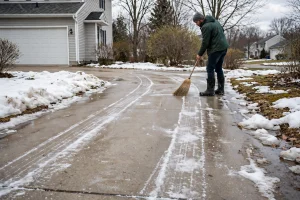
- Clear snow and ice by hand first. The less material on the driveway, the less product you need. This guide on how to melt ice on your driveway walks through shoveling, pretreating, and applying de-icer the right way.
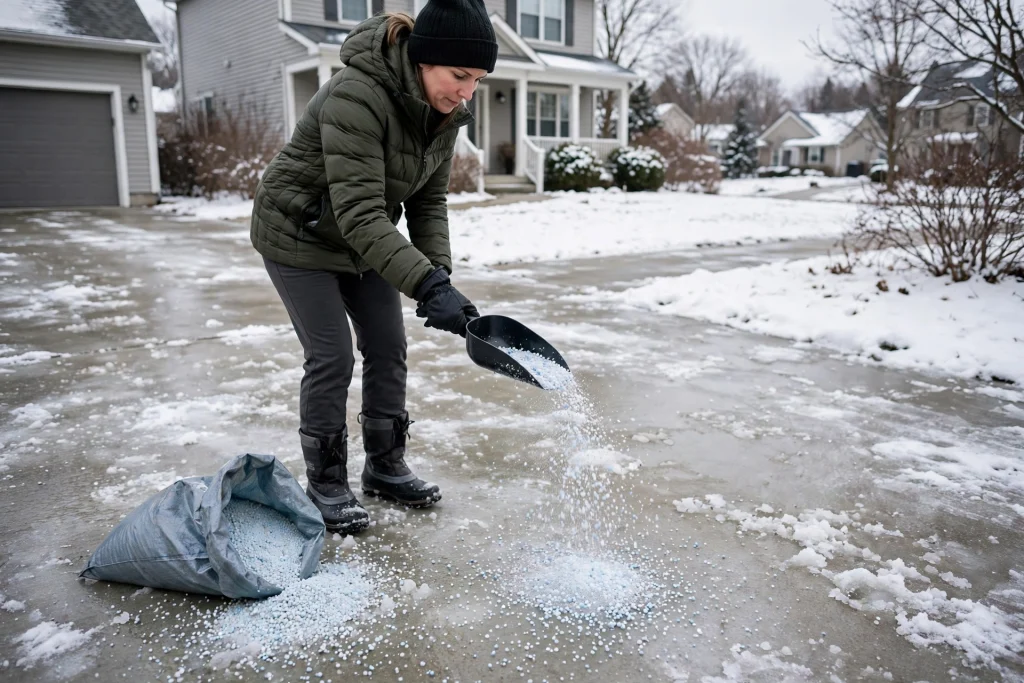
- Follow the label rate. More product does not melt ice faster. It leaves more brine to soak into the slab.
- Remove slush and meltwater. Shovel salty slush off the driveway instead of letting it sit and refreeze.
- Keep water from pooling. Low spots and downspouts that drain across the driveway keep the concrete saturated, which raises the risk of freeze-thaw damage.
- Seal the concrete. A compatible penetrating sealer can reduce the penetration of water and de-icing solutions into sound concrete. How long that protection lasts depends on the product, surface condition, exposure, and the manufacturer’s maintenance guidance. Here is when sealing a concrete driveway after pressure washing makes sense.
Be Extra Careful With New Concrete
Newer concrete is especially vulnerable to de-icer exposure before it has had adequate curing and drying time. Many concrete-industry groups recommend avoiding chemical de-icers during the first winter, but follow the installer or concrete supplier’s guidance for your specific slab. This post on new concrete curing time explains why the first months matter.
Concrete quality matters too. A slab that was finished poorly or poured without enough entrained air is more likely to scale, whatever product you use. If your driveway is already flaking, this guide to concrete spalling explains what causes it and how serious it is.
Ice Melt and Concrete FAQs
Is any ice melt completely safe for concrete?
No. Any chemical de-icer can increase risk under the wrong conditions, whether by adding to freeze-thaw cycling, reacting with the cement paste, or both. Using less product, clearing slush, and keeping the concrete sealed and well drained reduce that risk.
Is magnesium chloride safer for concrete than rock salt?
Not necessarily. Magnesium chloride is often described as safer because it is less corrosive to metal. Laboratory research, however, has linked concentrated magnesium chloride solutions to chemical attack on cement paste. Neither product is free of risk, and how much you use matters.
Does calcium chloride damage concrete?
It can. Calcium chloride works in colder conditions than rock salt, but research has linked concentrated solutions to chemical damage in concrete, and it can still contribute to freeze-thaw scaling. Follow the label rate and remove slush after it works.
Can I use ice melt on new concrete?
Be especially cautious. Many concrete-industry groups recommend avoiding chemical de-icers during the first winter. Follow the installer or concrete supplier’s guidance for your slab, and use sand for traction in the meantime.
Does sealing concrete protect it from ice melt?
It helps. A compatible penetrating sealer can reduce how much water and de-icing solution sound concrete absorbs. It does not make concrete immune, and how long it lasts depends on the product and the manufacturer’s maintenance guidance.
Keep Your Concrete in Shape Through Spring
Even careful de-icing leaves residue behind by the end of winter. Clearing it early helps your driveway start the warm season clean. Here is what to know about whether salt damages concrete and how to deal with the residue.
If your driveway needs a deeper cleaning, our team provides professional driveway and concrete cleaning across the Richmond area, with pressure matched to the condition of the surface. Call (804) 754-5200 for a free quote.