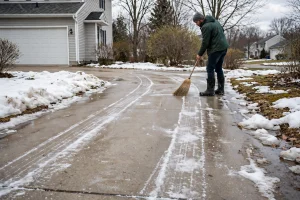

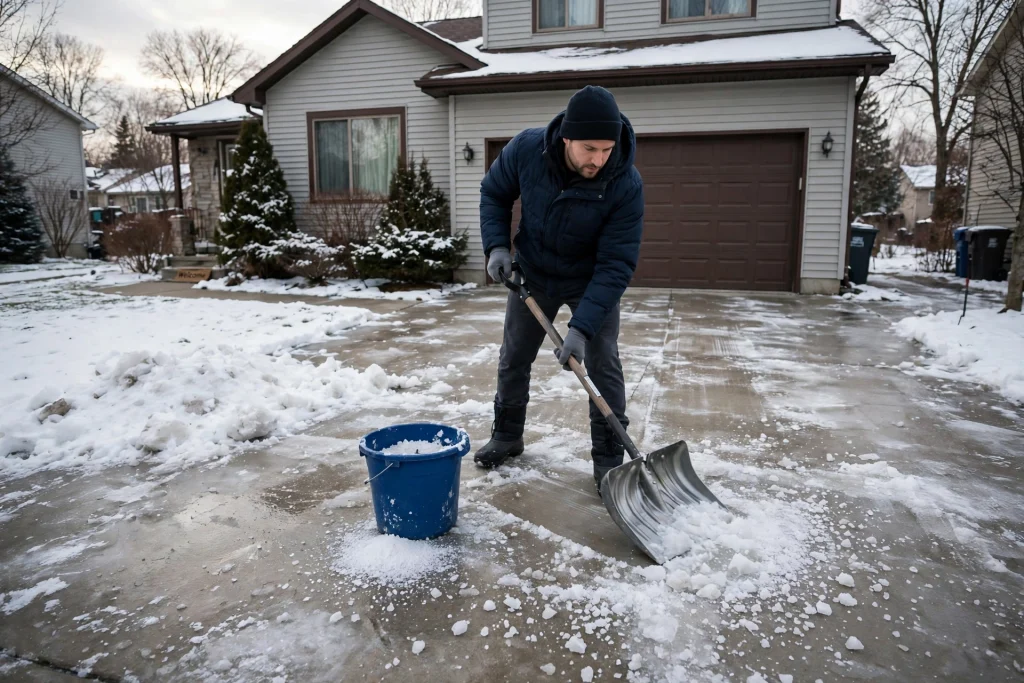
An icy driveway turns a simple trip to the mailbox into a balancing act. The usual reaction is to grab a bag of salt and throw down a heavy layer, then wait. That works, sort of, but it uses more product than you need and leaves your concrete sitting in salty slush for days.
The better approach is simple: remove as much as you can by hand, melt only what is left, and time it so ice never gets a strong grip on the slab. Here is how to do that while keeping your driveway in good shape.
Clear First, Then Melt
De-icers are built to break the bond between ice and pavement, not to dissolve inches of snow. The less material sitting on the driveway, the less product you need and the faster it works.
- Shovel early and often. Clearing snow before cars drive on it keeps it from packing down into a hard, icy layer that is much harder to remove.
- Use the right tool. A plastic shovel or one with a plastic or rubber edge clears snow without scraping the concrete. Metal blades and edges can scratch and chip the surface, especially on older or weathered slabs.
- Push, do not chop. For thin ice, a push-style scraper held at a low angle lifts ice better than hacking at it.
Once the driveway is cleared down to a thin layer, a small amount of de-icer can finish the job.
Pre-Treat Before the Storm
The easiest ice to remove is ice that never bonds to the driveway. Applying a light layer of de-icer before freezing rain or snow starts, often called anti-icing, keeps a thin film of brine between the concrete and whatever falls on top. When it is time to shovel, snow and slush lift off instead of sticking.
Pre-treating usually takes less product than trying to melt ice after it has formed. It works best right before precipitation begins. Check the label first, since not every product is meant for pretreatment, and keep in mind that pavement temperature, not just air temperature, decides whether it will work. Heavy rain at the start of a storm can wash it away, so watch the forecast and apply it as close to the start as you can.
How to Apply De-Icer the Right Way
How you spread a de-icer matters as much as which one you choose.
- Read the label first. Every product has its own application rate and lowest working temperature. More product does not melt ice faster. It just leaves more residue on the concrete.
- Spread a thin, even layer. A handheld spreader gives better coverage than tossing it by hand, and it keeps you from dumping piles in one spot.
- Focus on the paths you use. Walkways, steps, and tire tracks need treatment more than every square foot of the slab.
- Remove the slush. Once the ice loosens, shovel the slush off the driveway. Leaving salty meltwater in place lets it soak into the concrete and refreeze overnight.
Choosing the product is its own decision. If pets use your driveway, see this guide to pet safe ice melt. If protecting the concrete is your priority, this breakdown of ice melt safe for concrete compares the common options.
Be especially cautious with de-icers on newer concrete, and follow the installer or concrete supplier’s recommendations before using them. This post on new concrete curing time explains why young concrete needs extra care.
How to Break Up Thick Ice on a Driveway
Thick, packed ice takes patience. Trying to chip through it with a metal tool is the fastest way to gouge the concrete underneath.
- Start with a light de-icer application. As the de-icer begins working, it can create channels through the ice and weaken its bond to the pavement.
- Give it time. Let it work for the time listed on the label. Rushing this step usually means more chopping later.
- Lift, do not hack. Slide a flat scraper or plastic-edged shovel under the loosened sections and pry them up. Keep tools at a low angle so they do not dig into the slab.
- Repeat in layers. For very thick ice, work in a few rounds rather than trying to clear it all at once.
- Let the sun help. If the forecast shows a sunny afternoon, clearing what you can and waiting for midday warmth often finishes the job with less product.
How to Melt Ice Without Salt
Salt is not the only option, but most alternatives work better for traction or small patches than for a whole driveway.
- Sand or traction grit: It does not melt ice, but it gives immediate grip. It is useful on steps, slopes, and walking paths, and it needs to be swept up once the ice is gone.
- Hot water: It clears a small patch quickly, but the water cools fast and can refreeze into an even slicker layer. It is a short-term fix for something like a car door that will not open, not a driveway solution.
- Rubbing alcohol mixtures: These appear in online DIY recipes, but they are impractical for a full driveway and add unnecessary handling and flammability concerns. Use a purpose-made de-icer or traction material instead.
- Vinegar and fertilizer: Both show up in online tips, but neither is designed for use on pavement. Fertilizer can wash into storm drains and stain concrete, so it is better left on the lawn.
For anything bigger than a small patch, early shoveling plus a measured amount of de-icer is still the most reliable approach.
How to Keep Your Driveway From Freezing Over Again
Ice often forms in the same places every winter. Fixing the reasons behind it saves effort all season.
- Redirect downspouts. A downspout that drains across the driveway creates a sheet of ice after every thaw. Extend it so water empties onto grass instead.
- Watch low spots and shaded areas. These hold meltwater and stay frozen longest. Clear slush from them first and treat them before the evening freeze.
- Push snow piles downhill. Pile snow where meltwater drains away from the driveway, not where it will run back across the slab and refreeze.
- Clear meltwater before sunset. Water left on the driveway in the afternoon is tomorrow morning’s ice.
Repeated melting and refreezing is also hard on the concrete itself. It is a major factor behind concrete spalling, the flaking damage many homeowners notice after winter.
How to Melt Ice on Driveway FAQs
Should you put salt on the driveway before it snows?
Sometimes. If the product label allows pretreatment and the pavement temperature is within its working range, a light application before freezing precipitation can help reduce bonding. Avoid pretreating too early if rain may wash the product away.
Does dish soap melt ice?
Not on its own in any meaningful way. Dish soap appears in homemade recipes mostly to help the mix spread. Any melting comes from the alcohol or hot water in the mix, and those effects are short-lived on a full driveway.
What melts ice without damaging concrete?
The gentlest approach is mechanical: shovel early, scrape with plastic-edged tools, and use sand for traction. When you do need a de-icer, use the smallest amount that works and clear the slush afterward. For a product-by-product comparison, see this guide to ice melt safe for concrete.
Is it bad to use a metal shovel on concrete?
It can be. A metal blade dragged hard across the surface, or used to chop ice, can scratch and chip concrete, especially if the slab is older or already flaking. A plastic shovel or a plastic-edged blade is safer for routine clearing.
How long does ice melt take to work?
It depends on the product, the temperature, and how thick the ice is. Most labels list a working time, and colder temperatures slow everything down. Clearing as much snow as possible first helps any product work faster.
Start Spring With a Clean Driveway
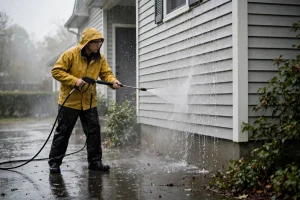
Even careful de-icing leaves salt residue, grime, and stains behind by the end of winter. Rinsing early in spring removes residue that can remain around joints, edges, and porous areas after winter. Here is what to know about whether salt damages concrete and how to clear the residue.
If your driveway needs more than a hose, our team provides professional driveway and concrete cleaning across the Richmond area. Call (804) 754-5200 for a free quote.