
Soft washing has become the default recommendation for residential exterior cleaning across Richmond for good reasons. It’s safer for siding, roofs, soffits, and fences. It kills mold and algae at the cellular level. The results last 4–6 years versus 6–18 months for pressure washing. For the majority of surfaces on a residential property, professional soft washing is the right answer.
But soft washing isn’t a universal answer. There are specific surfaces where mechanical force is what’s actually needed, and chemistry alone won’t get the job done. This guide is the honest counterpart to our other soft washing content: where soft washing falls short, where pressure washing wins, and how to think about the right method for each surface on your property.
The Honest Answer: Soft Washing Isn’t Always Right
Soft washing kills biological growth. That’s what it’s optimized for mold, mildew, algae, lichen, bacteria, and the visible stains those organisms cause. The chemistry penetrates cell walls and oxidizes internal structures. It’s extraordinarily effective on living contamination.
Some surfaces have dirty appearance that isn’t primarily biological. Embedded dirt in concrete pores. Tire marks on a driveway. Oil stains in a garage entryway. Ground-in grime in paver joints. Soot from an outdoor cooking area. None of these are biological they’re mechanical contamination. The chemistry that excels at killing organisms doesn’t lift them. You need physical force.
This is why most exterior cleaning jobs in Richmond involve both methods: soft washing on the biological surfaces, pressure washing on the hardscape. Any service that uses only one method everywhere is using the wrong tool somewhere.
Concrete Driveways and Sidewalks
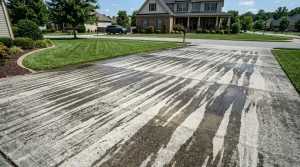
Concrete is the most common surface where pressure washing wins definitively. Driveways accumulate dirt deeply embedded in the porous concrete surface every car that drives in, every footstep, every windborne dust deposit pushes more grime into the pores. Tire marks oxidize on the concrete surface and become permanent stains without mechanical removal. Oil drips from cars penetrate the porous surface and create patches that no chemistry alone can lift.
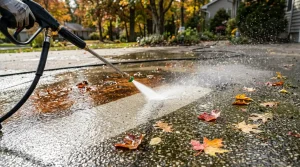
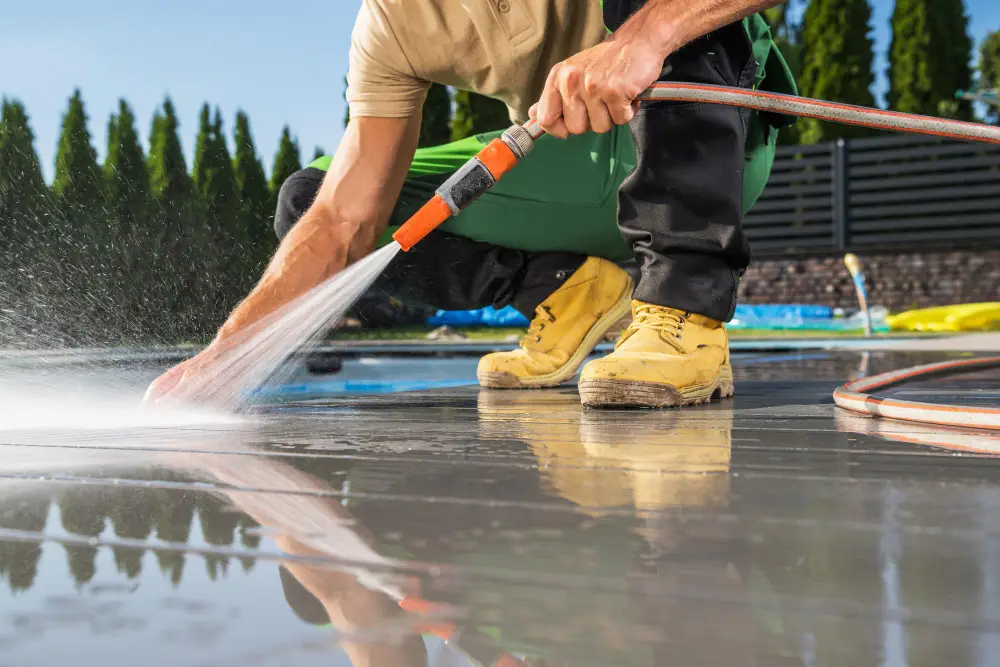
Pressure washing at typical concrete-cleaning pressures (2,500–3,500 PSI) lifts the embedded grime from the pores, removes the surface oxide layer that holds tire stains, and exposes clean concrete. The visual transformation is dramatic a pressure-washed driveway typically looks several shades lighter than it did before cleaning.
Soft washing on the same driveway would address any biological growth (the green-black tinge that develops on shaded sections), but wouldn’t touch the embedded dirt, tire marks, or oxidation. The driveway would still look gray and dirty after a soft wash because the contamination isn’t what soft wash targets. For concrete driveway and sidewalk work, see our driveway and concrete cleaning service in Richmond.
Paver Patios and Walkways
Pavers have the same fundamental cleaning challenge as concrete, with an additional complication: the joint sand between pavers. The joints accumulate dirt, organic debris, and weed seeds that settle in and embed. Soft washing kills the biological component (the moss and algae growing in shaded joints) but doesn’t lift the accumulated dirt and debris.
Pressure washing on pavers lifts the embedded contamination from both the paver surface and the joint sand. The downside is that pressure washing also displaces some joint sand, which usually needs to be replaced (re-sanded) after cleaning. This is a normal part of paver maintenance — the alternative of not cleaning leaves both visible dirt and an environment where weeds and moss continue to spread.
On paver patios, the combined approach often works well: pressure wash for the deep clean, soft wash for any biological growth on adjacent siding, fence, or shade-cover surfaces. Different surfaces, different methods, single visit.
Brick: It Depends
Brick is the surface where the right method depends most heavily on what you’re actually cleaning. For biological growth on brick green algae, black mildew, lichen patches — soft washing is the right answer. The chemistry kills the organism without damaging the brick or eroding the mortar joints.
For embedded dirt, soot from a fireplace or grill, salt staining from de-icing chemicals, or efflorescence (the white mineral deposits that form on brick), pressure washing may be needed but at lower pressures (1,500–2,000 PSI) and with extra care to avoid mortar erosion. Aging mortar especially is vulnerable: every pressure wash takes a small amount of mortar out of the joints, and over many cycles, repointing becomes necessary.
The judgment call depends on the contamination. A reputable cleaning service will assess your specific brick situation and recommend the right approach sometimes soft wash alone, sometimes combined, occasionally pressure wash only.
Dumpster Pads and Commercial Parking Areas
Commercial properties have their own set of surfaces that need pressure washing rather than soft washing. Dumpster pads and parking lots accumulate the worst of both worlds: heavy biological growth (moss, mildew, algae in shaded areas) AND embedded dirt, oil, grease, and food waste residue.
The right approach for these surfaces is typically a hybrid: pressure washing as the primary method to lift the embedded contamination, with chemistry added to the wash water (or applied separately) to address the biological component. The pressure does the mechanical work; the chemistry kills what survives the rinse.
Commercial properties in Richmond looking at exterior cleaning programs should be planning around the combined approach, not pure soft washing. See our commercial pressure washing services for the full commercial breakdown.
Storefront Sidewalks and Heavy-Foot-Traffic Concrete
Storefront sidewalks have their own particular challenges. Food and drink spills from passing customers, gum residue, cigarette burns, and the accumulated dirt from constant foot traffic create surface contamination that’s heavily mechanical rather than biological. Pressure washing is the right tool here, and many retail storefronts in Richmond use pressure washing on a regular schedule to maintain curb appeal.
Soft washing on a storefront sidewalk would address any moss in shaded sections but wouldn’t touch the gum, food residue, or staining from constant traffic. The dirty appearance would remain even after a careful soft wash.
Garage Floors and Concrete Around Mechanical Equipment
Garage floor concrete typically has motor oil staining, transmission fluid drips, antifreeze residue, and other mechanical contamination that’s purely industrial in nature. No biological component, no chemistry-targeted growth just embedded petroleum products and mineral staining.
Pressure washing combined with degreasing chemistry is the correct approach for garage floors. Soft washing would do essentially nothing useful here the contamination isn’t what it’s designed to address.
Wood Decks: A Special Case
Wood decks are an interesting middle case. Soft washing is the right answer for most deck cleaning because the visible darkening is usually biological (mildew, algae, fungal growth) rather than mechanical. Soft washing kills the organism and restores the wood’s natural color without damaging the surface fibers.
Pressure washing on wood is risky. Even at lower pressures (1,500 PSI), pressure water can lift surface wood fibers, leaving a fuzzy or weathered appearance that wasn’t there before cleaning. This is particularly visible on older decks or softer woods. For most deck cleaning, soft washing produces better results and avoids the surface damage.
The exception: heavily stained decks with embedded grime that soft washing alone doesn’t fully address. In those cases, light pressure washing followed by soft washing (or vice versa) can work. But the default for residential decks should be soft washing.
The Combined Approach: Most Real Jobs
Most exterior cleaning jobs in Richmond benefit from a combined approach. A typical residential project might look like:
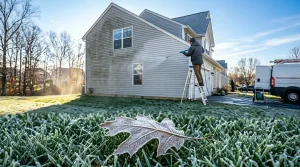
- Soft wash: House siding, soffits, fascia, gutters, fence, deck. All the biological-growth surfaces.
- Pressure wash: Driveway, sidewalks, paver patio. All the hardscape with embedded contamination.
- Sometimes both: Brick (depending on contamination type), heavily stained concrete, transition zones between hardscape and landscape.
This combined approach delivers the best results on every surface and respects the appropriate method for each. Look for cleaning services that explicitly offer both methods and have the equipment and experience for each that’s a signal of a service that’s actually optimizing for your property rather than defaulting to one tool everywhere.
Frequently Asked Questions
If pressure washing damages so many surfaces, why is it still used at all?
Because for the surfaces it’s right for, it’s irreplaceable. No amount of chemistry will lift tire marks from a concrete driveway or remove embedded dirt from paver joints. Pressure washing is the wrong tool for many residential surfaces but the right tool for hardscape. Both methods have their proper applications.
How do I know which method my house needs?
Walk around your property and inventory the surfaces. Anything biological-looking (green, black, fuzzy, streaked) needs soft wash. Anything that’s hardscape with embedded dirt or staining (driveway, sidewalk, patio) needs pressure wash. Most homes have both and most jobs we quote in Richmond involve both methods. A free assessment from a reputable service will tell you exactly which surfaces need which method.
Can a cleaning company use pressure washing safely on my siding if I really want pressure washing?
It can be done at significantly reduced pressure with specialized fan tips, but the results are inferior to soft washing in every way: shorter-lasting clean, more uneven coverage, higher risk of damage, no cellular kill on the organism. There’s no reason to choose pressure washing on siding when soft washing produces better results without damage.
What about stucco soft wash or pressure wash?
Always soft wash. Stucco erodes under pressure washing, particularly at corners, control joints, and around windows where the finish coat is thinner. EIFS (exterior insulation finish systems) are even more vulnerable. Soft washing is the only safe method for both stucco and EIFS.
Are there surfaces where neither method should be used?
A few — delicate vintage paint, certain types of stained or oiled wood, some specialty finishes. These usually warrant gentle hand-cleaning rather than power cleaning of any kind. Tell your cleaning service about any unusual surfaces before they start work.
Do you offer both methods?
Yes we use whichever method is right for the surface. Most residential jobs involve both: soft washing on biological surfaces, pressure washing on hardscape. For commercial properties, see our commercial pressure washing service. For driveway and concrete specifically, see our driveway cleaning service.
Bottom Line
Soft washing is the right method for the majority of your home’s exterior surfaces — siding, roof, soffits, fences, stucco, brick, decks. Pressure washing is the right method for hardscape — driveways, sidewalks, paver patios, dumpster pads, garage floors. The right cleaning approach for your home is almost always a combination of both methods, applied to the right surfaces.
If you’ve been quoted by a service that’s using only one method everywhere, ask why. The honest answer is that the right method depends on the surface and any cleaning service worth hiring will explain which method belongs where. Request a free assessment and combined-method quote or call us with questions. For more reading: the complete soft washing guide, the lifespan comparison between methods, and our existing driveway and concrete cleaning service.