
Parking lots and dumpster pads are the two surfaces most commercial properties under-clean and the two surfaces that generate the highest rate of tenant complaints, code enforcement issues, and customer-facing perception problems when they’re not maintained. The visible portions of a commercial property get scheduled cleaning attention; the hardscape behind the building often goes a year or more between cleanings, accumulating leachate, oil, organic stains, and odor that drives away tenants and triggers municipal inspections. This guide is for property managers, business owners, and HOA boards across Richmond looking to address the hardscape side of commercial cleaning properly. For the broader service breakdown, see our Richmond commercial pressure washing page.
The short version: parking lots benefit from quarterly cleaning, dumpster pads need monthly attention. The equipment needed is different from standard pressure washing hot water, surface cleaners, degreasing solutions, and environmental discipline around runoff management. Most general cleaning vendors aren’t equipped for this work; specialized commercial pressure washing services are.
Why Dumpster Pads Are the Worst Surface Most Properties Have
Dumpster pad neglect is the most common commercial cleaning failure. The pad accumulates everything that drips, leaks, or falls out of the dumpster: food waste leachate (the brown liquid that pools under restaurant and grocery dumpsters), bin lubricant from the trash truck’s pickup mechanism, mineral residue from cleaners and chemicals tenants dispose of, oils and greases from food prep, and the general organic decay that creates the characteristic dumpster pad smell.
Left uncleaned, several things go wrong simultaneously:
- Smell intensifies. Bacteria and decomposition products build up in the porous concrete. The smell that was a problem in summer becomes a problem year-round. Wind carries it across the property.
- Code complaints. Municipal code in most Richmond-area jurisdictions covers dumpster area cleanliness. Inspectors who find leachate buildup, visible decay, or strong odor can issue violations that trigger costly remediation requirements.
- Pest attraction. Rats, raccoons, and insects are drawn to the decomposition. Pest control becomes a recurring expense that scheduled cleaning would have prevented.
- Tenant complaints. Restaurant and food service tenants particularly notice when dumpster smell affects their patios, drive-throughs, or back-of-house operations. Complaints escalate to property management quickly.
- Surface deterioration. The acids in food waste leachate slowly etch concrete surfaces. Long-term, the pad surface becomes pitted and harder to clean. Replacement costs are an order of magnitude higher than scheduled cleaning costs.
Dumpster Pad Cleaning Equipment and Method
Standard cold-water pressure washing isn’t sufficient for dumpster pad cleaning. The grease and organic content needs hot water to lift effectively, and the surface needs degreasing solution to fully address embedded contamination.
The right equipment and method:
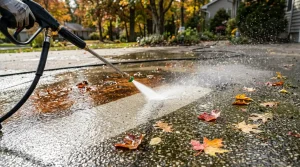
- Hot-water pressure washer. 180–200°F water lifts grease, food residue, and organic stains that cold water can’t touch. Trailer-mounted or skid-mounted units with diesel-fired heating are standard for commercial dumpster pad work.
- Pre-treatment with degreasing solution. Surfactant-based degreasers applied before pressure washing break down embedded oils and food residue. Dwell time of 10–15 minutes lets the chemistry do its work before the rinse.
- Surface cleaner attachment. Rotating-head surface cleaners (sometimes called “deck cleaners” or “flat surface cleaners”) provide even coverage and consistent pressure across the concrete pad. Dramatically more efficient than handheld pressure washing.
- Drainage management. Most dumpster pads connect directly to storm drains. Environmental compliance requires controlling where runoff goes — capturing the wash water for proper disposal, or filtering through silt-sock containment, depending on local regulations.
- Final sanitizing rinse. After the cleaning pass, a final low-concentration sanitizer rinse reduces residual bacteria and prevents fast re-establishment of odor and decay.
Parking Lot Cleaning: Different Problem, Different Method
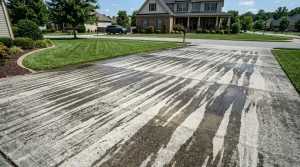
Parking lot contamination is mostly mechanical rather than organic tire marks, oil drips from vehicles, brake dust accumulation, gum from foot traffic, and general dirt and grime. The cleaning method emphasizes mechanical force more than chemistry.
- Standard pressure washing at 2,500–3,500 PSI. Sufficient for most parking lot contamination. Surface cleaners maintain even pressure across the lot for efficient coverage.
- Oil and grease spot treatment. Individual oil spots get pre-treated with degreasing solution before the main wash. Significantly improves the visual result compared to general pressure washing alone.
- Gum removal. Cold pressure water alone doesn’t lift dried gum effectively. Heat or specialty solvents are needed for accumulated gum in main traffic lanes and pedestrian crossings.
- Striping protection. Painted parking lot striping can be damaged by aggressive pressure washing. Operators should adjust pressure and angle when working near stripes, particularly older or already-faded paint. Significant restriping budget can be avoided by careful cleaning technique.
For driveway-specific concrete cleaning at residential and small commercial scale, see our existing driveway and concrete cleaning service in Richmond.
Frequency: Monthly vs Quarterly
Cleaning frequency depends on traffic level, tenant mix, and seasonal factors. Here’s the typical Richmond breakdown:
| Property Type | Dumpster Pad | Parking Lot |
| Restaurant / food service | Monthly | Quarterly |
| Grocery / supermarket | Monthly | Quarterly |
| Multi-tenant retail | Monthly | Quarterly |
| Office building | Quarterly | Semi-annual |
| Medical / clinical | Monthly | Quarterly |
| Industrial / warehouse | Quarterly | Semi-annual |
| HOA common area dumpster | Quarterly | Semi-annual |
Food service and grocery generate dramatically more dumpster contamination than office or industrial properties. Monthly cleaning prevents the accumulated buildup that creates odor, code complaints, and surface deterioration. Quarterly is sufficient for office and industrial properties where dumpster contents are mostly paper and non-organic waste.
Parking lots can usually run on quarterly to semi-annual cycles, with attention to seasonal factors: spring after pollen season, late summer before the worst of the heat, early winter to address fall debris, and mid-winter if salt-truck and snowplow residue is a concern. Read our complete commercial scheduling guide for the seasonal logic.
Environmental Considerations and Runoff Management
Commercial parking lot and dumpster pad cleaning generates runoff that, in many jurisdictions, can’t legally be discharged to storm drains without treatment. The wash water contains oils, organic material, detergents, and dissolved contaminants that flow into local waterways unless captured.
Compliance requirements vary by jurisdiction, but typical commercial cleaning protocols include:
- Storm drain protection. Temporary covers or filter inserts that prevent contaminated runoff from entering the storm sewer during cleaning.
- Wash water capture. Containment with vacuum recovery the wash water is captured, contained, and disposed of through a sanitary sewer connection or hauled to a treatment facility.
- Pre-treatment of high-contamination areas. Oil stains and other concentrated contamination are pre-treated to reduce what enters the rinse water in the first place.
- Records of cleaning activity, runoff management methods used, and disposal documentation. Useful for any subsequent code inspection or compliance audit.
A commercial pressure washing vendor working without environmental discipline is exposing the property to regulatory risk that the vendor’s insurance often doesn’t cover. Verify your vendor’s environmental compliance approach before contracting.
Tenant and Customer Complaints as Early Warning
Tenant and customer complaints about smell, appearance, or pest activity near parking lots and dumpster zones are the leading indicator that cleaning frequency is insufficient. By the time a property manager hears about it, the underlying problem has typically been building for weeks or months. Treating complaints as the trigger for cleaning means cleaning is always reactive and always behind.
Better practice: schedule cleaning at the frequency that prevents complaints from ever happening. Monthly dumpster pad cleaning prevents the smell threshold from being crossed. Quarterly parking lot cleaning prevents the visual deterioration that customers and tenants notice. The cost of scheduled prevention is dramatically lower than the cost of repeated complaint resolution.
This is also why dumpster pad cleaning fits into broader commercial programs rather than being booked as standalone work. The schedule discipline and operational continuity matter more than the individual cleaning visits.
Other Surfaces Where Pressure Washing Is the Right Method
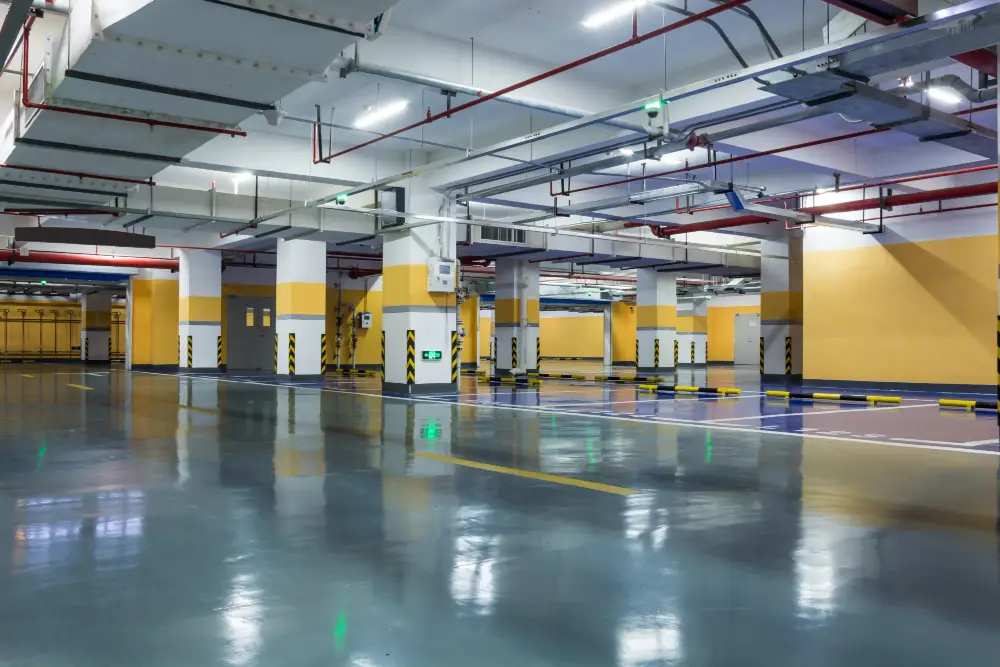
Concrete-heavy surfaces benefit from pressure washing for the same reasons parking lots do — embedded mechanical contamination that chemistry alone can’t lift. The relevant categories include garage floors, loading dock concrete, service alley pavement, and certain hardscape walkways. Each has its own specifics, but the underlying principle is the same: mechanical contamination needs mechanical cleaning.
Conversely, this is exactly the kind of cleaning where soft washing is the wrong method. Soft washing kills biological growth at the cellular level it doesn’t lift tire marks or oil stains. Read our complete breakdown of when soft washing is the wrong method for context on method selection.
Frequently Asked Questions
How much does dumpster pad cleaning cost?
Typical Richmond dumpster pad cleaning runs $150–$400 per visit for a single dumpster enclosure, depending on size, contamination level, and access. Monthly recurring programs typically secure better per-visit pricing. Multi-dumpster properties (apartment complexes, large retail strips) run higher — usually $400–$1,200 per visit for the full scope.
How much does parking lot pressure washing cost?
Parking lot cleaning is typically priced per square foot or per stall, with smaller lots running roughly $0.06–$0.12 per square foot and larger lots dropping to $0.04–$0.08 per square foot at scale. A typical 100-stall lot runs $800–$2,400 per cleaning visit. Quarterly programs secure better pricing than ad-hoc visits.
Will pressure washing damage my parking lot striping?
Done correctly, no operators adjust pressure and angle when working near painted lines. Aggressive pressure washing on older or already-faded striping can damage paint and require restriping. Discuss this with your vendor before scheduling; reputable commercial cleaners are aware of striping protection and adjust technique accordingly.
Do you handle environmental compliance for runoff?
Yes — we follow EPA and local stormwater management practices for commercial cleaning, including storm drain protection, runoff capture where required, and proper disposal of wash water. Documentation is available for code compliance or audit purposes.
Can dumpster pad cleaning happen during business hours?
Yes — dumpster pad cleaning typically can run during regular business hours since most tenants don’t interact with dumpster zones. The smell during cleaning may be temporarily noticeable, so we typically schedule between trash pickup days when the dumpster is emptier and the smell is lower. For retail with patios near dumpster zones, after-hours or off-peak scheduling is preferred.
What about dumpster enclosures with overhead screens or gates?
Enclosure screens, gates, and overhead structures get cleaned at the same time as the pad itself when the scope is set up correctly. The metal or wood enclosure surfaces accumulate grime and benefit from the same cleaning visit as the concrete pad. Specify enclosure cleaning when scoping the work it’s often missed if not explicitly included.
Bottom Line
Parking lots and dumpster pads are where most commercial properties have their cleanliness reputation tested and where most properties currently fall short. The right approach is scheduled cleaning at appropriate frequencies (monthly for high-contamination dumpsters, quarterly for parking lots), using the right equipment (hot water, surface cleaners, degreasing solutions), with environmental compliance built into the operational approach. The cost is modest relative to the operational impact of getting it wrong.
If your Richmond commercial property’s hardscape needs attention, request a walkthrough and proposal or get in touch directly. For more reading: the case for quarterly commercial scheduling, how we approach storefront and retail cleaning, office building exterior coordination, and our existing driveway and concrete cleaning service in Richmond.