
Office building exterior cleaning is operationally more involved than residential or retail cleaning. The buildings are larger. The surfaces are more varied. The tenants are more sensitive to disruption. The property management chain is longer. The insurance requirements are stricter. None of this is hard to do well, but it requires the right operational discipline and that discipline is the difference between a cleaning vendor that office property managers keep on contract for years and a vendor that gets switched out after one bad experience. This guide is for property managers and building owners across Richmond running office buildings single-tenant, multi-tenant, mid-rise, and office park settings. For the broader commercial cleaning service breakdown, see our Richmond commercial pressure washing page.
The short version: office building cleaning works best on a quarterly cadence (sometimes monthly for high-visibility downtown properties), scheduled for weekends or weeknight evenings, with property management coordination, COI on file, and crew continuity from visit to visit. The cleaning work itself is the easy part getting the access, communication, and coordination right is what separates a good vendor from a bad one.
What Makes Office Buildings Different
Office building cleaning differs from residential and retail work in several specific ways:
- Tenant density and sensitivity. A 50,000-square-foot office building might have 30–50 tenant businesses inside. Each has its own operational concerns. Cleaning that disrupts any of them generates complaints to property management. After-hours scheduling isn’t a nice-to-have it’s a requirement.
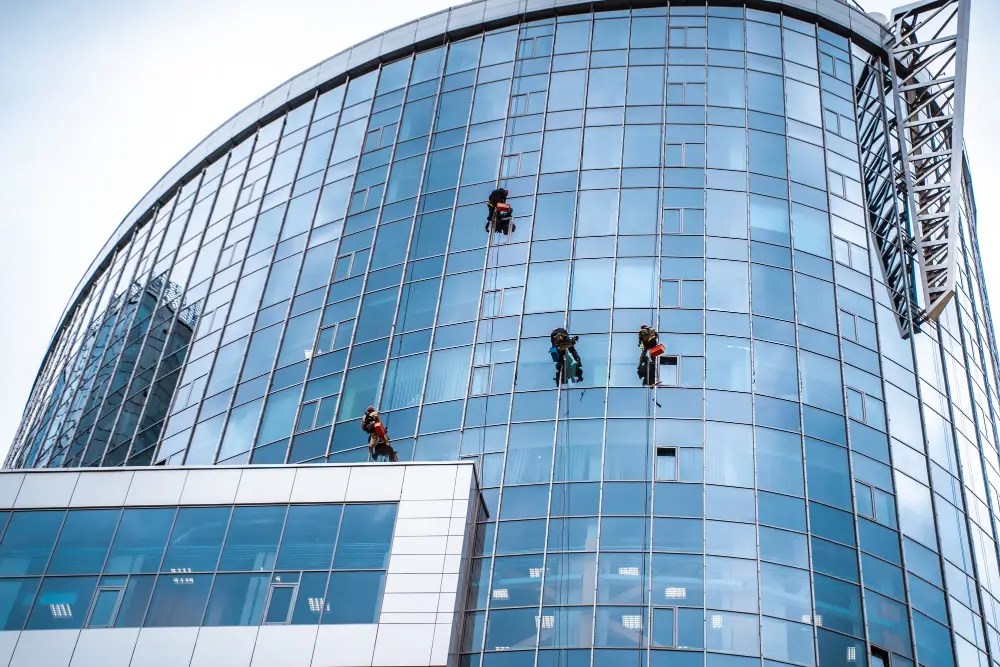
- Multi-story access requirements. Two-story facades are workable from ground level with extended-reach equipment. Three-story and taller buildings often need lift access — boom lifts, scissor lifts, or in some cases swing-stage rigging. The equipment and OSHA compliance involved is meaningfully different from residential work.
- Surface variety. A typical office building includes brick, EIFS or stucco, glass curtain wall sections, metal panels, signage, awnings or canopies, and ground-level concrete or pavers. Different surfaces need different methods and a vendor who pressure-washes everything is going to damage the surfaces that need soft washing.
- Loading dock and dumpster zones. Behind-the-building areas that tenants don’t see but inspectors do. These accumulate the worst of the property’s grime and need their own attention see our
- Signage and brand-element cleaning. Tenant signage, building identification, monument signs, and channel letters all need scheduled attention. These are also some of the highest-visibility surfaces they affect how tenants and visitors perceive the property quality.
- Property management chain. Office buildings often have property owner → property management company → on-site facility manager → tenant relationships. Cleaning vendors typically work through property management, but understanding the full chain matters for communication, escalations, and contract structuring.
Multi-Story Facade Considerations
Cleaning a multi-story office building facade involves more than just height. Several practical considerations affect how the work gets done:
- Reach equipment selection. Boom lifts (articulating or telescopic), scissor lifts, water-fed poles, or swing-stage rigging each has its place depending on the building configuration. Articulating boom lifts are most flexible for varied facade geometry but require ground access. Water-fed poles work for surfaces reachable from the ground with extended reach. Swing-stage is typically reserved for very tall buildings or unique architectural features.
- Ground protection and water management. Cleaning solution and runoff has to be managed responsibly covered storm drains where appropriate, controlled rinse-down direction, protection of landscaping and pedestrian areas below. This is where the operational discipline of the cleaning vendor matters most.
- Pedestrian safety zones. Active work zones above sidewalks need temporary barriers, signage, and sometimes flag-person coordination depending on the surface and traffic. Office buildings with public sidewalk frontage have additional safety requirements.
- OSHA compliance. Fall protection, lift operation certification, scaffold tagging, and ground spotter requirements all apply for elevated work. A cleaning vendor working on a multi-story office building should have current OSHA training documentation available.
Glass Entrances and Revolving Doors
Office building entrances are some of the most-touched surfaces in the entire property. The glass at the main entrance accumulates fingerprints, oils, and smudges that show within hours of cleaning. Revolving doors collect dust and oils in the rotation mechanism that affects how they operate. Door handles and kick plates show wear and accumulation that visitors notice immediately.
Entrance cleaning typically runs on a more frequent schedule than the rest of the exterior weekly or biweekly for high-traffic properties, monthly minimum for most office buildings. The work involves: glass cleaning (separate scope from pressure washing different equipment), hardware polishing, threshold concrete cleaning, and door mat replacement or rotation. Most cleaning vendors specialize in one of these or another; some bundle them all into a single entrance-cleaning package.
Tenant Communication and Notification
Office building tenants get blamed less for cleaning disruption than they should. Most disruption is preventable with better communication. Standard practice:
- 48–72 hour advance notification. Property management sends email to all tenants confirming the cleaning schedule. Specifics: which areas, what dates and times, any access restrictions, what to expect (noise, water spray, smell).
- Same-week reminder. Day-of or day-before reminder for the affected access areas. Useful especially for delivery routes, food service, and any tenants who’d otherwise have a bad encounter with the cleaning work.
- Visible signage during work. Wet floor signs, temporary barriers, route signage if normal entries are affected. The signage prevents the kind of bad-encounter that triggers complaints.
- Post-visit summary. Property management receives confirmation that work is complete, with photos if relevant. Tenants who reported issues get a follow-up. This communication discipline reduces tenant friction dramatically over time.
The cleaning vendor should be drafting and providing the tenant notification language. Property managers shouldn’t have to write it themselves. Vendors that don’t help with this part are creating extra work for the property manager that should be part of the service.
After-Hours and Weekend Scheduling
Office building cleaning during business hours is rarely acceptable. The disruption to tenants — noise, water, blocked access, smell generates complaints. The right schedule is after-hours or weekend, and the practical reality of how that’s structured matters.
Standard scheduling windows for Richmond office buildings:
- Saturday daytime (9:00 AM – 4:00 PM). Most common window. Tenants typically aren’t on-site, ground access is clear, security can be coordinated, and the work doesn’t require night-time lighting setup.
- Sunday daytime (9:00 AM – 4:00 PM). Alternative to Saturday for buildings with Saturday occupancy (some tech, some legal, some financial firms work Saturdays). Sunday is usually the cleaner option.
- Weeknight evenings (6:00 PM – 11:00 PM). For urgent cleaning or properties where weekend work isn’t available. Requires night-time lighting and more careful coordination, but works for ground-level and lower-floor work.
- Holiday weekends. Some property managers schedule the deepest cleaning visits around holiday weekends when tenant occupancy is lowest. Memorial Day, Labor Day, July 4th week, and the Christmas-New Year window are common.
Loading Dock and Dumpster Zone Cleaning
Behind-the-building zones — loading docks, dumpster enclosures, service entrances accumulate the worst of an office building’s contamination. Food waste from tenant kitchens, leachate from dumpsters, oil and grease from deliveries, and general grime build up quickly in these high-use, low-visibility areas.
Cleaning these zones requires different equipment than facade work: hot-water pressure washers are typically necessary, surface cleaners help with concrete pad efficiency, and degreasing solution is often applied before the rinse. Drainage and runoff management is also more involved — these areas often connect directly to storm sewers and need careful environmental handling.
Most office buildings benefit from monthly cleaning of these zones, even when the visible exterior is on quarterly. The smell and code-complaint risk of dumpster zones makes them the surface where under-investment shows up first. See our complete guide on parking lot and dumpster pad cleaning for the specifics.
Property Management Coordination
Most office building cleaning runs through property management, not directly through building ownership. This is generally the right structure property managers have the operational bandwidth to coordinate scheduling, vendor communications, and tenant notifications that building owners typically don’t. The cleaning vendor’s primary working relationship is with the property manager.
Practical coordination patterns that work well:
- Single point of contact. One person at the property management company who handles all cleaning vendor communication. One person at the cleaning vendor who handles all property management communication. Continuity matters more than reach.
- Standardized communication channels. Email for non-urgent, phone for urgent. SMS for after-hours emergencies. Defined response time expectations on each.
- Quarterly business review. Brief meeting (15–30 minutes) every quarter to review the cleaning program, address any concerns, and plan upcoming work. Catches issues before they become escalations.
- Documentation discipline. Every cleaning visit has a record date, scope, crew, completion confirmation, any issues noted. Property managers should have access to this history.
Frequently Asked Questions
How often should an office building exterior be cleaned?
Quarterly is the standard for most office buildings — sufficient to prevent buildup, infrequent enough to keep cost predictable. Higher-visibility downtown properties may benefit from monthly attention. Read our complete guide on commercial cleaning frequency.
Do you have the equipment for multi-story facade work?
Yes we own and operate boom lift equipment, water-fed pole systems, and the support equipment for multi-story work up to typical Richmond mid-rise heights. For taller buildings or specialized access situations, we coordinate with rigging or scaffold partners and remain the responsible vendor through the project.
Can you provide a Certificate of Insurance and additional insured naming?
Yes within 24 hours of request, same-day in most cases. We carry $2M general liability and workers’ compensation. Property management companies and building owners can be named as additional insured on the COI.
How do you handle vehicle traffic during ground-level work?
Parking lots, drive aisles, and loading dock approaches are coordinated with property management for either temporary closure during work, traffic flagging, or scheduling during low-traffic windows (early Saturday morning, Sunday). Most office building work happens when vehicle traffic is minimal.
What’s the typical cost for a multi-story office building cleaning?
Cost varies dramatically by building size, story count, surface mix, and access conditions. A typical 30,000 SF multi-tenant office building in Richmond runs $1,200–$3,500 per cleaning visit; quarterly programs run $4,800–$14,000 annually. Larger properties or higher-visibility downtown buildings can run substantially higher. The right way to get an accurate number is a property walkthrough and written proposal.
Do you handle both pressure washing and soft washing on office buildings?
Yes different surfaces need different methods. Brick, concrete, and hardscape clean with pressure washing. EIFS, painted facades, awnings, and most signage need soft washing. A vendor that uses pressure washing on everything is going to damage the surfaces that need soft wash. See our complete soft washing services for the methods we apply on commercial work.
Bottom Line
Office building exterior cleaning is one of the most operationally demanding commercial cleaning categories and one of the most rewarding for property managers when it’s done right. The cleaning vendor that brings the right insurance documentation, the right scheduling discipline, the right tenant communication, and the right method-selection for different surfaces becomes a long-term partner that takes work off the property manager’s plate rather than adding to it.
If you’re rethinking your office building cleaning vendor or building a new program from scratch, request a property walkthrough and proposal or get in touch directly. For more reading: how we approach HOA and community association cleaning, the parking lot and dumpster pad services that complement office work, and the rationale for quarterly cleaning scheduling.