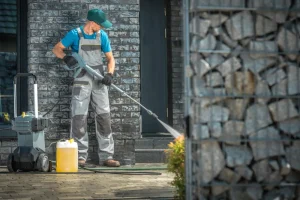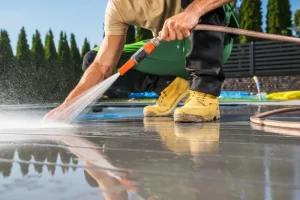

If you’ve ever had your house, roof, or fence pressure washed and watched the mold, algae, or green-black stains return within a year, you’ve experienced the central limitation of pressure washing on residential surfaces: it doesn’t kill what’s growing. It just rinses the visible part of the colony off the surface. The surviving cells regrow, and you’re back where you started in 6–18 months.
This is the headline reason professional soft washing in Richmond has largely replaced pressure washing for residential exterior cleaning. The results last 4 to 6 times longer — typically 4–6 years versus 6–18 months. This guide explains the cellular biology behind that difference, the cost implications over a decade of homeownership, and where the math really matters.
The Numbers: 4–6 Years vs. 6–18 Months
Here’s the practical lifespan comparison across common residential exterior surfaces:
| Surface | Soft Wash Lifespan | Pressure Wash Lifespan |
| Asphalt shingle roof | 4–6 years | 6–18 months (also damages shingles) |
| Vinyl/Hardie siding | 4–6 years | 12–24 months |
| Stucco/EIFS | 4–6 years | Not safe (causes damage) |
| Brick (above ground) | 4–6 years | 1–3 years (also damages mortar) |
| Wood/vinyl fence | 3–4 years | 1–2 years |
| Concrete driveway | N/A — needs pressure | 1–2 years |
Note the concrete row at the bottom: concrete is the one common surface where pressure washing actually outperforms soft washing, because the cleaning task there is mechanical (lifting embedded dirt and stains) rather than biological. For most other residential surfaces, the comparison is unambiguous — soft wash lasts roughly 4 times longer on average.
Why Pressure Washing Doesn’t Actually Kill Anything
This is the core reason the lifespan difference exists. Pressure washing is a physical process — water at high velocity hits a surface, contamination is mechanically removed, and the result looks clean. But the organisms causing the dirty appearance (mold, mildew, algae, lichen, bacteria like Gloeocapsa magma) aren’t just sitting on the surface as inert debris. They’re living colonies anchored into the microscopic texture of whatever they’re growing on.
The visible part of the colony — the dark stain or the fuzzy green coating — is just the surface layer. The living cells are also embedded in pores, cracks, surface texture, and microscopic features the high-pressure water can’t reach without damaging the material. After pressure washing, the surface looks clean but is essentially a recovery scenario for a living colony with intact reproductive capacity.
Within weeks, the surviving cells start dividing and growing back. Within months, the visible stain returns. The pressure wash bought a season of clean appearance, but didn’t actually solve the underlying problem.
How Soft Washing Kills at the Cellular Level
Soft washing solutions work chemically rather than mechanically. The active ingredient is sodium hypochlorite (the same chemical family as bleach, applied at calibrated concentration with surfactants — see our deeper dive on sodium hypochlorite). The chemistry penetrates the cell walls of the organism and oxidizes the internal structures, killing the cells outright.
During the typical 10–20 minute dwell time, the visible signs of cell death appear: dark stains fade as the pigmented cells lose structural integrity, moss colonies turn brown as the tissues die, lichen breaks its chemical bond with the substrate. By the end of dwell time, the colony is dead — not rinsed away, dead.
After the dead organism is rinsed off the surface, regrowth has to start from scratch. New airborne spores have to land on the surface, find moisture and nutrients, and slowly establish new colonies. That process takes years. The first visible signs of new growth typically appear 3–4 years after a soft wash, and the surface reaches the point where another treatment is worthwhile around the 4–6 year mark.
What “Lasting Longer” Actually Means Visually
There’s a difference between technical lifespan and aesthetic lifespan. A soft-washed surface stays visibly clean for the full 4–6 years for most homeowners. A pressure-washed surface typically looks clean for 6–12 months, starts showing visible regrowth around month 12–15, and is noticeably dirty by month 18.
The pattern is more dramatic on roofs than on siding. On asphalt shingle roofs, the black streaks caused by Gloeocapsa magma return as faint shadows within 6 months of a pressure wash and are fully back to pre-cleaning appearance within 12–18 months. Soft-washed roofs typically stay visibly clean for 5+ years.
On siding, the difference is more about pattern than intensity. Pressure-washed siding tends to show uneven regrowth — some sections clear faster than others, leading to a mottled, blotchy appearance. Soft-washed siding regrows more uniformly when it eventually does, but that’s many years later.
The Cost Economics Over 10 Years
Lifespan matters because it determines total cost of ownership over time. Here’s the math for a typical Richmond home over a 10-year window:
| Scenario | Cleanings Over 10 Years | Estimated Total Cost |
| Pressure wash every 12–18 months | 7–10 cleanings | $3,500–$8,000 |
| Soft wash every 4–6 years | 2 cleanings | $1,200–$2,400 |
| Estimated savings | — | $2,300–$5,600 |
These numbers vary by property size and surfaces involved, but the directional math is reliable: soft washing typically costs more per visit but dramatically less over a decade. The savings are real even before considering the cost of damaged shingles, cracked siding, or other surface damage from repeat pressure washing.
For roof-specific numbers, see our complete roof cleaning cost guide for Richmond. The economics there are even more favorable for soft washing because of the shingle protection aspect.
Where Lifespan Difference Matters Most
Some surfaces benefit more than others from the longer-lasting soft wash results. The biggest impact is on:
- Asphalt shingle roofs. Every cleaning interval is also a damage interval if pressure washing is used. Stretching from 6 cleanings over 10 years to 2 cleanings means dramatically less shingle wear, longer roof lifespan, and lower total roof maintenance costs.
- Vinyl siding. The repeated pressure-washing cycle is part of why vinyl siding ages faster than it needs to. Soft washing stretches the cleaning interval and eliminates the pressure-related material stress.
- Stucco and EIFS. These materials shouldn’t be pressure washed at all — soft washing is the only safe option. The longevity of stucco depends on not eroding it with cleaning.
- Multi-surface homes. If you’re cleaning siding, soffits, gutters, and roof on the same schedule, the soft wash approach saves substantial time and money across all surfaces simultaneously.
Surfaces Where Pressure Washing Wins Anyway
It’s worth being clear that pressure washing is the right method for some surfaces — and on those surfaces, the lifespan comparison flips. Pressure washing concrete driveways typically lasts 1–2 years, which is roughly the same lifespan you’d get from any cleaning method on driveways because the failure mode is new dirt and stains rather than biological regrowth.
For complete guidance on which surfaces need pressure washing rather than soft washing, see our breakdown of surfaces that need pressure. And for concrete-specific work, see our existing driveway and concrete cleaning service.
There’s also a relevant lesson here for commercial property owners thinking about scheduling: the soft wash longevity makes a quarterly or semi-annual schedule unnecessary in most cases. For commercial properties on a quarterly pressure washing schedule, the quarterly cadence is appropriate for hardscape (parking lots, dumpster pads), but soft-washed siding and signage typically extend to annual or longer intervals.
Frequently Asked Questions
Why don’t all cleaning companies use soft washing if it lasts so much longer?
Two reasons. First, soft washing requires different equipment and chemistry knowledge than pressure washing — companies that haven’t invested in either default to what they have. Second, some companies prefer the repeat-revenue model of pressure washing every 12–18 months over the longer-cycle model of soft washing every 4–6 years. The right method for the homeowner isn’t always the most profitable method for the contractor.
Can pressure washing and soft washing be combined?
Yes — and on most homes, they should be. Use soft washing on siding, roof, soffits, fences, and stucco. Use pressure washing on driveway, sidewalks, paver patios, and other hardscape. Many of our customers in Richmond book combined cleaning visits where both methods are used on the appropriate surfaces. This is the optimal approach for most properties.
Does the 4–6 year lifespan apply in all climates?
Roughly, yes. Hotter and more humid climates (like coastal Florida or the deep South) may see slightly faster regrowth — closer to 3–4 years. Drier climates may see longer — 5–7 years. Richmond’s climate is in the middle of that range, so 4–6 years is the standard expectation here.
What happens if a soft-washed surface gets dirty before 4–6 years?
Surface dirt and dust are different from biological growth. A house can get visibly dusty within months of cleaning without any organic regrowth happening — that’s a different cleaning need (often handled with a simple low-pressure rinse) than full re-treatment. The 4–6 year number refers specifically to organic regrowth requiring another full soft wash.
Is one soft wash enough, or does it take multiple treatments to clear an old roof or heavily mildewed siding?
One soft wash is sufficient for most jobs, including heavily contaminated surfaces. The chemistry kills the organism in a single application; you don’t need to treat repeatedly to get the kill. If a single soft wash isn’t producing visible results, that usually indicates the concentration wasn’t calibrated correctly or the dwell time was too short — both of which are fixable in the same visit.
Bottom Line
Soft washing results last 4 to 6 times longer than pressure washing because soft washing kills the organism at the cellular level rather than just rinsing surface growth. The economic implications over a decade are substantial: fewer cleanings, less surface wear from repeated pressure exposure, and better long-term aesthetics. For asphalt shingle roofs specifically, the difference is also a matter of shingle preservation — every pressure wash strips granules; soft washing strips none.
If your home or roof in Richmond is overdue for cleaning, the right method matters as much as the cleaning itself. Request a free soft washing quote or call us to discuss your property. For more reading: the complete homeowner’s guide to soft washing, how the method applies to roofs specifically, and when to use pressure washing instead.