
White powder, streaks, or crusty deposits on brick are often signs of efflorescence. Efflorescence forms when water dissolves soluble salts inside masonry, carries those salts toward the surface, and then evaporates. The water disappears, but the salts remain behind.
The deposit itself is often removable, but repeated efflorescence is a clue that moisture is moving through the brick or mortar. That is why the safest approach is not simply to scrub harder. First identify the moisture source, then use the least aggressive cleaning method that removes the visible salts without damaging the masonry.
What Does Efflorescence Look Like on Brick?
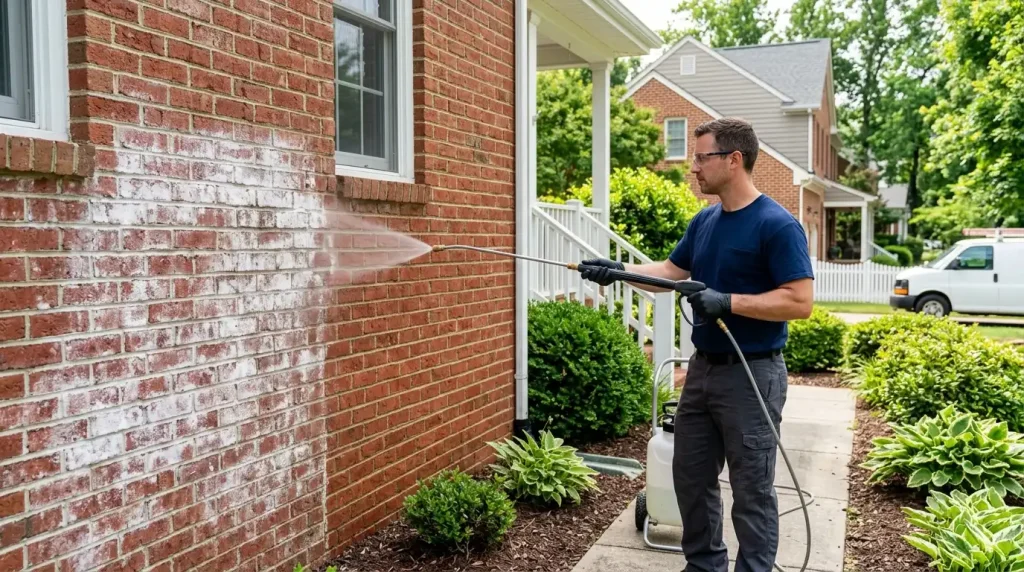
Efflorescence commonly appears as a white, gray, or pale powder on brick faces and mortar joints. It may look dusty and easy to brush away, or it may form heavier streaks and crusty deposits where moisture repeatedly evaporates.
The appearance can vary with the type of salt, the amount of moisture, the porosity of the masonry, and how long the deposit has been present.
What Causes Efflorescence on Brick?
Three conditions are generally needed for efflorescence to appear: soluble salts must be present, water must reach those salts, and the moisture must move toward an exposed surface where it can evaporate.
Salts in Brick, Mortar, Soil, or Nearby Materials
Soluble salts can come from brick, mortar ingredients, concrete, soil, deicing products, cleaning chemicals, or other materials that contact the wall.
Moisture Moving Through the Masonry
Rain, roof runoff, leaking gutters, defective flashing, rising damp, irrigation, plumbing leaks, poor drainage, and construction moisture can all introduce water into masonry.
Evaporation at the Surface
As moisture travels through porous brick and mortar, it can carry dissolved salts with it. When the water evaporates at the face of the wall, those salts remain as a visible deposit.
Is Efflorescence the Same as Mold?
No. Efflorescence is a mineral salt deposit, while mold and algae are biological growth.
Efflorescence: Typically white, dry, powdery, and brushes away easily.
Biological Growth (Mold/Algae): Appears green, black, brown, or slimy, and thrives in shaded or persistently damp environments.
Correct identification matters because a cleaner formulated for biological growth will not necessarily resolve a mineral salt and moisture issue.
Is Efflorescence Harmful to Brick?
Light surface efflorescence is often mainly an appearance issue, but persistent salt movement deserves attention because it shows that moisture is traveling through the masonry.
Repeated wetting and salt crystallization (subflorescence) can contribute to masonry deterioration in certain conditions. The more critical warning sign is often the hidden water source rather than the visible white deposit itself.
How to Remove Efflorescence From Brick Safely
Step 1: Let the Masonry Dry
If the wall is actively wet, give it time to dry before deciding how much efflorescence is present. Cleaning a saturated wall may only draw more dissolved salts to the surface as additional moisture evaporates.
Step 2: Start With a Dry Brush
For loose, powdery efflorescence, begin with a clean, stiff natural or nylon bristle brush. Brush the deposit away from the wall and collect the loose material rather than washing it deeper into the masonry. Avoid wire brushes, which can scratch brick and leave behind metal particles that eventually rust and stain.
Step 3: Use Plain Water Only if Needed
If dry brushing does not remove the deposit, a limited amount of clean water may help dissolve remaining salts. Use gentle rinsing rather than high pressure, and avoid saturating the wall. The goal is to remove surface deposits without forcing water deeper into porous masonry.
Step 4: Use a Dedicated Masonry Cleaner for Stubborn Deposits
Heavier or older efflorescence may require a cleaner specifically formulated for masonry salt deposits. Choose a product compatible with both your brick and mortar type, follow the manufacturer’s dilution and dwell instructions, and test a small, inconspicuous area first. Avoid aggressive acids that can etch masonry, alter mortar integrity, or alter surface coloring.
Step 5: Rinse Completely When the Product Requires It
If a masonry cleaner requires rinsing or neutralization, follow the product label exactly. Leaving chemical residue on the wall can cause secondary staining or long-term surface degradation.
Step 6: Let the Wall Dry and Recheck It
After cleaning, allow the brick to dry completely before evaluating the final result. If the white deposit quickly returns, treat recurrence as a moisture migration issue rather than simply repeating an aggressive wash.
Can You Pressure Wash Efflorescence Off Brick?
Pressure washing is usually not the best first method for efflorescence because the deposit is caused by salt movement through wet masonry, not just surface dirt.
High pressure can erode mortar joints, scar softer brick faces, or drive additional water into the wall structure. If water pressure is used at all, it should be strictly conservative, tested first, and appropriate for the current condition of the masonry.
This is especially critical on older properties. For further details on vintage masonry care, read Can You Pressure Wash Historic Brick Homes in Richmond, VA?.
Why Efflorescence Sometimes Comes Back After Cleaning
Cleaning removes visible surface salts; it does not remove deeper salt pockets or stop water intrusion. If moisture continues entering the masonry, new salts migrate toward the surface and form another visible white deposit as the water evaporates.
Common Moisture Sources to Check
Leaking or overflowing gutters
Downspouts discharging too close to the wall foundation
Failed flashing or compromised roof drainage
Cracked, missing, or deteriorated mortar joints
Sprinklers repeatedly spraying the wall
Soil or mulch piled directly against the masonry
Poor yard grading directing runoff toward the foundation
Concealed plumbing or irrigation leaks
Residual construction moisture in newer builds
Should You Use Muriatic Acid on Brick Efflorescence?
Muriatic acid should not be used as a routine DIY treatment for efflorescence. Strong acids can severely etch mortar, permanently bleach or discolor brick, corrode adjacent metal fixtures, and present significant handling hazards.
While professional masonry restoration may utilize controlled acidic formulations, these products are calibrated to specific masonry types and neutralized properly. Raw acid and unmeasured application create far more structural harm than the efflorescence itself.
Can Vinegar Remove Efflorescence From Brick?
Vinegar is frequently suggested as a mild household alternative, but it is not universally appropriate for every brick and mortar system. If mechanical dry brushing fails to dislodge the deposit, a purpose-made, pH-balanced masonry cleaner with explicit compatibility guidelines is safer and far more predictable than household acid mixtures.
What About Efflorescence on Historic Brick?
Historic masonry requires extra caution because vintage brick is often significantly softer, and historic lime mortars are vulnerable to aggressive washing and chemical erosion.
National Park Service (NPS) preservation guidance emphasizes identifying masonry types, understanding previous surface treatments, testing cleaners on inconspicuous test patches, and using the gentlest effective means possible. On historic structures, persistent efflorescence should always be evaluated alongside mortar condition, flashing integrity, and drainage pathways.
When Efflorescence May Point to a Larger Problem
A small amount of temporary efflorescence on new construction often subsides as initial moisture leaves the masonry. However, recurring or thick crusty deposits on an established structure warrant a closer look.
Look beyond the surface deposit if you notice:
Spalling, crumbling, or flaking brick faces
Sandy or deteriorating mortar joints
Interior drywall dampness or peeling wallpaper
Paint bubbling or lifting on adjoining surfaces
Salt rings returning within days of dry cleaning
What Not to Do
Do not start with high-pressure washing.
Do not use a zero-degree (pinpoint) nozzle on brick or mortar.
Do not use raw muriatic acid as a routine first treatment.
Do not scrub with wire brushes, which damage finishes and cause rust stains.
Do not saturate the wall with water merely to remove dry powder.
Do not apply waterproof sealers over damp walls to hide recurring efflorescence.
Do not ignore gutters, downspouts, or flashing defects when efflorescence recurs.
How to Help Prevent Efflorescence From Returning
Keep gutters clean and ensure downspouts discharge at least 5 feet away from the wall.
Direct all roof runoff and landscape grading away from masonry foundations.
Tuckpoint and repair cracked or missing mortar joints promptly.
Adjust lawn irrigation nozzles away from exterior walls.
Maintain foundation clearance by pulling mulch and soil several inches below brick ledges.
Avoid applying non-breathable sealers or coatings that trap internal moisture.
Use specialized masonry cleaners and breathable sealers only after the moisture source is corrected.
Frequently Asked Questions
Does efflorescence mean the brick is damaged?
Not necessarily. Light efflorescence is primarily an aesthetic issue, but recurrent deposits confirm that moisture and soluble salts are actively migrating through the wall. The root moisture problem must be resolved to prevent future deterioration.
Will efflorescence go away on its own?
Some light efflorescence on newly laid brick will dissipate naturally as building moisture dries out. On existing homes, efflorescence will continue returning as long as water infiltrates the masonry.
Can you brush efflorescence off brick?
Yes. Powdery efflorescence can easily be swept off using a clean, stiff nylon or natural bristle brush once the wall is thoroughly dry. Avoid using wire brushes.
Can pressure washing make efflorescence worse?
Yes. High-pressure water can push salts and moisture deeper into the masonry core, leading to heavier deposits once the wall dries out again, alongside potential mortar damage.
Is efflorescence mold?
No. Efflorescence is an inorganic mineral salt deposit left behind after water evaporation. Mold and algae are living biological growths that require targeted sanitizing cleaners.
Why does efflorescence keep coming back?
Recurrence means water is continuing to penetrate the wall cavity, dissolving internal salts and pushing them to the surface. Cleaning only addresses the visible symptoms; sealing leaks and improving drainage fixes the cause.
Final Takeaway
Efflorescence on brick is a clear visual indicator that water and dissolved mineral salts are moving through your masonry. The safest, most effective remediation always begins with dry brushing, moving to controlled rinsing or dedicated masonry cleaners only when necessary.
Rather than treating efflorescence as standard surface dirt, locate and correct the active moisture pathway to keep your brick clean, sound, and protected over the long haul.