
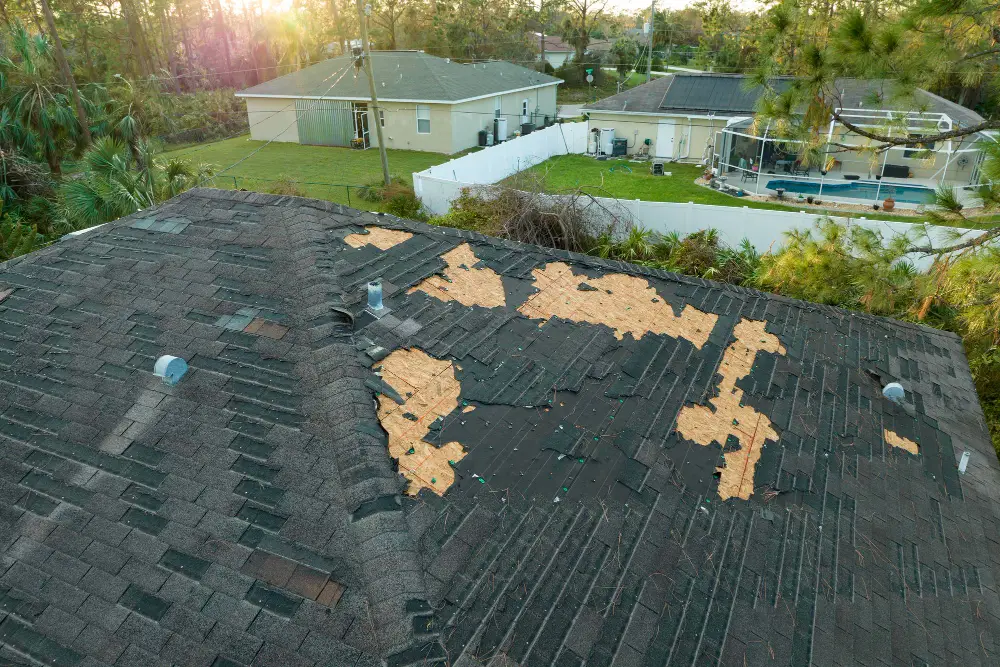
Black streaks on asphalt shingle roofs are common enough that a lot of homeowners assume they’re normal. Just part of how roofs age. Something to deal with eventually, or maybe not at all.
That assumption turns out to be pretty costly. Those streaks are not just dirt or weather staining. They’re a living organism that is actively feeding on your roof, and algae on roof surfaces causes damage that accumulates year after year until the shingles fail ahead of schedule.
Knowing what’s actually happening up there changes how you think about what looks like a minor cosmetic issue.
What’s Causing the Black Streaks
The dark discoloration that appears as streaks or patches on asphalt shingles is almost always caused by Gloeocapsa magma, a type of cyanobacteria that feeds on the limestone filler used in asphalt shingles. It travels by spore, which means it spreads from one roof to neighboring roofs and from one section of a roof to another.
The dark coloring comes from a protective coating the organism produces to shield itself from UV radiation. That coating is what makes the streaks visible, but the actual damage is happening below the surface, in the limestone granules that give asphalt shingles their durability.
Why It Spreads So Quickly
Once Gloeocapsa magma establishes on a roof, it has everything it needs to expand. The limestone in the shingles provides food. Moisture from rain and dew provides water. And shade from trees or dormers provides protection from the UV exposure that would otherwise slow its growth.
In humid climates like Virginia’s, it spreads faster than in drier parts of the country. A roof that looks clean in spring can have visible streaking by early fall.
How Algae Damages the Roof
Granule Loss
The granules embedded in asphalt shingles protect the underlying asphalt layer from UV degradation. They’re designed to stay in place for the rated lifespan of the shingle, which for most residential roofs is 20 to 30 years.
Algae on roof surfaces disrupts this by feeding directly on the limestone granules. As the organisms extract nutrients, the granules loosen and begin to wash away in rain events. You can often see this in the gutters of affected homes. Dark-colored granules collecting at the downspout are a sign that the shingles are losing their protective layer faster than they should be.
Once granule loss starts, it accelerates. The exposed asphalt degrades faster under UV exposure, and the shingles become brittle and begin to crack.
Moisture Retention
Healthy asphalt shingles shed water. Shingles with algae growth retain more moisture because the biological material on the surface holds water against the shingle instead of allowing it to run off.
That retained moisture creates two problems. First, it supports further biological growth, including moss and lichen, which cause even more aggressive surface damage. Second, it increases the freeze-thaw stress on the shingles during cold months. Water that gets under a shingle and freezes expands, forcing the shingle away from the roof deck and breaking the seal that keeps water out.
Lichen & Moss Progression
Algae on roof surfaces often leads to moss and lichen if left untreated, and these organisms do more direct physical damage than algae alone.
Moss grows in thick mats that hold water continuously against the shingles. Its root-like structures physically penetrate the shingle material, breaking it apart from below. Lichen bonds to the surface of the shingle at a chemical level, making it much harder to remove and leaving behind damage and discoloration when it’s finally treated.
The progression from algae to moss to lichen happens over a period of years, but it follows a predictable path when the initial algae growth isn’t addressed.
What This Means for Roof Lifespan
Roofing manufacturers design shingles to last under normal weathering conditions. Biological growth is not a normal weathering condition. It’s an accelerant.
A roof that develops algae growth early in its life and doesn’t get it treated can lose years of its rated lifespan. The granule loss, moisture retention, and eventual moss and lichen colonization all degrade the shingles faster than UV exposure and rain alone would.
For a homeowner who is planning to stay in their house for many years, this matters because roof replacement is one of the largest single home repair expenses. For a homeowner who plans to sell, it matters because roof condition is one of the first things a home inspector flags and buyers negotiate on.
Safe Roof Cleaning Methods
High-pressure washing is not the right approach for algae on roof surfaces. The pressure required to physically remove the organisms would also remove granules and damage the shingles.
The approach that works, and that most roofing manufacturers actually recommend, involves a low-pressure soft wash application of a cleaning solution that kills the organisms at the biological level. The solution breaks down the colony without requiring aggressive pressure, and the dead material rinses away over the following rain cycles.
This method removes the existing growth and slows re-colonization for a period of time, giving the shingles a chance to perform the way they were designed to.
When to Do Something About It
The best time to address algae on roof surfaces is before the streaks become obvious from the street, because by the time the discoloration is clearly visible, the growth has usually been established for at least a season.
If you can see streaking from the ground, the damage to the granule layer has already begun. Getting the roof cleaned at that point still makes sense and can stop the progression, but waiting longer will mean more accumulated damage.
Annual inspections of the roof, ideally done at the same time as gutter cleaning or other exterior maintenance, give homeowners the information they need to act before algae on roof damage reaches the point where it’s affecting the roof’s structural integrity.
A clean roof is not just a clean roof. It’s a roof that’s going to last as long as it was supposed to.