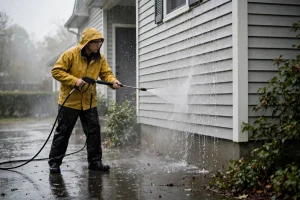

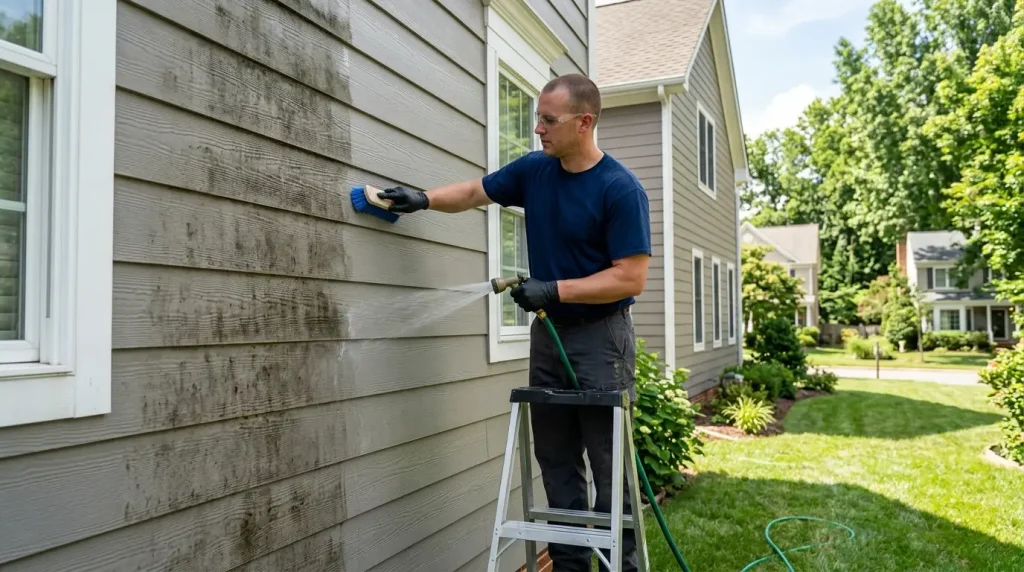
James Hardie does not recommend using a high-pressure power washer on Hardie siding. The manufacturer states that pressure washing can damage the surface and instead recommends a low-pressure water spray from a garden hose paired with a soft or medium nonmetal bristle brush.
That does not mean Hardie Board siding is difficult to maintain. Most routine dirt, grease, and mildew can be removed safely using gentle cleaning methods that protect the siding finish.
What James Hardie Recommends for Cleaning
James Hardie’s official care guidance recommends cleaning siding with a garden hose and a soft cloth or a soft-to-medium nonmetal bristle brush. The company also advises working in small sections, starting from the top down, and rinsing thoroughly so cleaners do not dry on the surface.
For routine care, James Hardie suggests cleaning the siding periodically, with maintenance frequency depending on local environmental conditions and exposure levels.
Why High-Pressure Washing Is a Risk
It Can Damage the Surface Finish
Hardie siding may have a factory-applied ColorPlus finish or a field-applied exterior paint coating. A concentrated high-pressure stream can gouge, strip, or prematurely wear the finish away—especially if the nozzle is held too close or kept stationary in one spot.
Water Can Be Forced Into Joints and Openings
High-pressure water easily penetrates behind horizontal laps, around trim edges, near wall penetrations, or into spots where caulk or flashing has aged or failed. Exterior siding is engineered to shed natural rainfall, not to withstand high-velocity water forced upward or directly into sealed joints.
Aggressive Cleaning Can Create an Uneven Appearance
If one section is washed more aggressively than an adjoining area, the wall can dry with visible patches, stripped sheens, or uneven color variations.
How to Clean Hardie Board Siding Safely
Step 1: Inspect the Siding First
Before applying water, check for cracked or missing caulk, loose trim boards, damaged panels, chipped paint, and gaps where water could enter behind the wall assembly. Cleaning should never be used as a temporary cover-up for underlying water intrusion issues.
Step 2: Remove Loose Dirt and Debris
Use a dry, soft-bristled brush or clean microfiber cloth to remove cobwebs, loose pollen, and windblown dust. Avoid stiff wire brushes or abrasive scouring pads, as these permanently scratch the surface.
Step 3: Rinse With a Garden Hose
For routine soil, James Hardie advises using clean, low-pressure water straight from a standard garden hose. Work in manageable, narrow sections from the top down.
Step 4: Wipe or Brush in the Direction of the Siding
When scrubbing is necessary, use a soft cloth and move side to side along the grain/profile of the plank, shingle, or vertical panel. For textured profiles, use a soft or medium nonmetal bristle brush.
Step 5: Rinse Completely
Never allow soapy water or cleaning solutions to dry on the siding. Rinse each treated section thoroughly with clean water until all residue is completely washed away.
Targeted Cleaning Methods by Stain Type
How to Remove Dirt and Dust
For basic atmospheric dust and light splash marks, start with a soft brush, a clean rag, and water from a garden hose. Most routine seasonal buildup does not require heavy detergents. Wash small sections at a time so run-off does not dry into unsightly drip streaks.
How to Remove Oil, Grease, or Organic Residue
James Hardie recommends mixing a mild liquid dishwashing detergent with water to tackle grease, road film, and stubborn organic oils. Apply the mixture using a soft cloth, rinse the cloth frequently in clean water, and immediately follow with a complete garden-hose rinse. The manufacturer cautions against harsh industrial chemicals, such as straight bleach or strong acids, for routine washing.
How to Clean Mold and Mildew
For active organic growth, James Hardie recommends using an approved, mildew-specific cleaner diluted with water according to the manufacturer’s directions. Apply the solution with a soft sponge or cloth, observe the recommended dwell time without letting it dry, wear appropriate protective gear, and rinse the area completely.
Can You Soft Wash Hardie Board Siding?
The term “soft washing” covers a variety of contractor systems, so the label alone does not guarantee compliance with James Hardie maintenance standards.
Any process used on Hardie siding must strictly respect the manufacturer’s low water pressure and chemical compatibility limits. If a professional service applies chemical treatments, the detergents, chemical ratios, dwell times, and rinsing stages must remain safe for fiber cement and its exterior coatings.
For an in-depth breakdown of low-pressure washing systems, see Pressure Washing vs. Soft Washing.
What About ColorPlus Technology?
James Hardie’s factory-applied ColorPlus Technology finish provides durable resistance against UV fading, but it still demands delicate maintenance. Always follow the specific ColorPlus care instructions provided by the manufacturer. Avoid stiff abrasives, high pressure, and incompatible solvent- or acid-based cleaners that compromise the factory seal.
Can You Use Bleach on Hardie Board Siding?
For ordinary dirt, oil, and grease, James Hardie explicitly advises against using harsh chemicals like bleach or muriatic acid. When dealing with mold and mildew, use a cleaner formulated specifically for exterior mildew removal rather than unmeasured, homemade bleach solutions that can discolor paints and dry out caulking.
Can You Use a Pressure Washer on a Low Setting?
James Hardie’s public maintenance documentation advises against pressure washers entirely, recommending a standard low-pressure garden hose instead. Turning down the regulator on a pressure washer still introduces risks of localized water intrusion around seams and overlaps, meaning a standard garden hose remains the safest, manufacturer-preferred option.
What NOT to Do When Cleaning Hardie Siding
Do not use a high-pressure power washer.
Do not use zero-degree (red) or turbo nozzles.
Do not use steel wool, wire brushes, or abrasive scrub sponges.
Do not let cleaners dry directly on the siding finish.
Do not apply raw bleach or muriatic acid for standard dirt cleaning.
Do not spray directly upward into overlaps, joints, or soffit vents.
Do not assume any soft washing method is automatically safe without verifying pressure levels and chemical pH.
How Often Should Hardie Siding Be Cleaned?
Routine siding maintenance frequency depends on local climate, tree canopy density, and building orientation. James Hardie suggests periodic washing, recommending a baseline cleaning every 6 to 12 months. Properties positioned in high humidity, heavy tree cover, or beside gravel roads will accumulate grime faster and may require semi-annual attention.
DIY Cleaning vs. Professional Siding Cleaning
Light, ground-level dirt can easily be tackled using a standard garden hose, bucket, and soft bristle brush.
Hiring a professional exterior cleaning team is the safer, more effective choice when:
Cleaning multistory walls where ladders create safety risks.
Mold, algae, and mildew are widespread across large exterior surfaces.
Access is obstructed by delicate landscaping or tight architectural layouts.
You want to ensure the cleaning chemistry adheres strictly to James Hardie’s warranty standards.
To weigh your options, read Professional Siding Cleaning vs. DIY.
Frequently Asked Questions
Can a pressure washer damage Hardie Board siding?
Yes. James Hardie’s official documentation states that pressure washers can strip paint, pit fiber cement, and force moisture into wall cavities. The manufacturer recommends a low-pressure garden hose with a soft or medium nonmetal bristle brush instead.
What is the best way to clean Hardie siding?
For regular dust and dirt, rinse with clean garden-hose water and wipe with a soft cloth or nonmetal brush. For sticky residue or oil stains, use warm water mixed with mild liquid dish soap.
Can I use bleach on Hardie siding?
James Hardie advises avoiding harsh chemicals like bleach or acid for routine cleaning. When mold or mildew is present, use a dedicated, siding-safe mildew remover applied strictly to label specifications.
Can I soft wash Hardie Board siding?
Yes, provided the contractor uses genuine low pressure (equivalent to garden-hose output) and manufacturer-safe detergents that will not harm fiber cement or ColorPlus finishes.
How often should Hardie siding be cleaned?
James Hardie recommends periodic cleaning roughly once every 6 to 12 months, depending on local humidity, pollen levels, and tree canopy coverage.
Should I clean Hardie siding from top to bottom?
Yes. Working in small, manageable sections from the top down prevents dirty run-off and cleaning solutions from streaking surfaces you have already rinsed.
Final Takeaway
When caring for James Hardie siding, high-pressure equipment is unnecessary and counterproductive. Preserving your siding’s durability and warranty requires simple, gentle methods: a low-pressure garden hose, a soft nonmetal brush, and mild, surface-safe detergents. For severe biological growth or multi-story structures, opt for gentle, low-pressure soft washing techniques that clean thoroughly without risking water intrusion or surface damage.