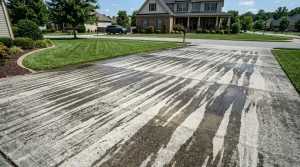

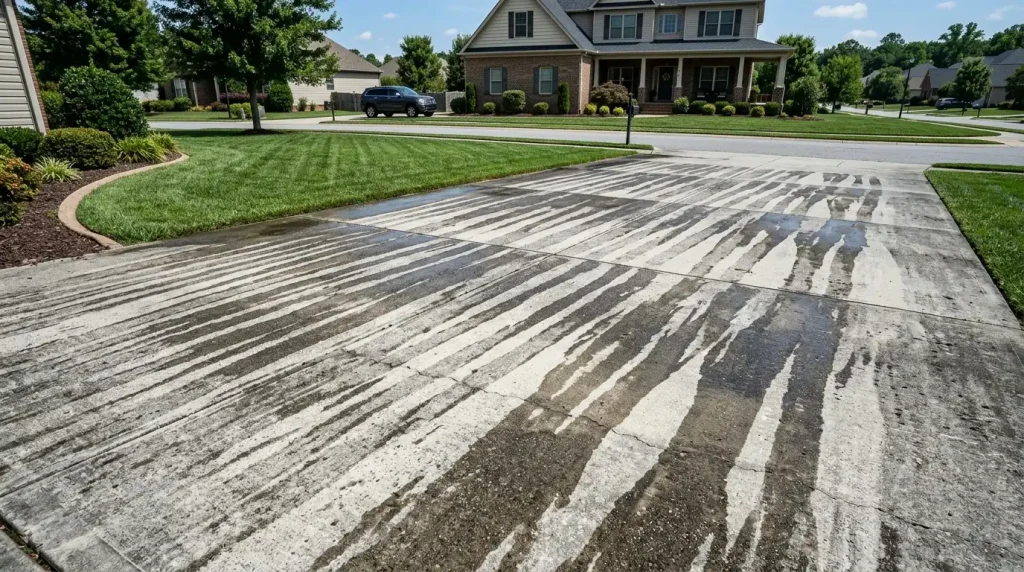
You hire someone to clean the driveway, they pack up and leave, and a day later you walk outside to find your concrete covered in stripes. Light bands, dark bands, and streaks running across the slab in a pattern that was not there before. It looks like someone dragged a rake through it. The driveway is cleaner than it was, and somehow it looks worse. Those marks have a name, and they come from a mistake that is easy to make and just as easy to avoid.
Zebra striping on concrete is one of the most common complaints after a driveway cleaning, and it points to how the job was done rather than to the concrete itself. Here is what causes it and how the right approach prevents it.
What Zebra Striping Actually Is
The stripes are not damage to the concrete, and that is the good news buried in the problem.
Uneven Cleaning Leaves a Pattern
Zebra striping happens when some parts of the slab get cleaned more than others. The light bands are where the surface got the full treatment, and the darker areas are where it did not. The contrast between the two creates the striped look. The concrete is fine. It just got cleaned unevenly, so it shows a pattern instead of one consistent color.
It Shows Up After Drying
The stripes often are not obvious while the concrete is wet, since everything looks dark and uniform when it is soaked. As the slab dries, the difference between the cleaned and less-cleaned areas comes out, and that is when the pattern appears. That delay is why people find the stripes the day after rather than right when the crew leaves.
Why It Happens
A few things cause the uneven cleaning behind the stripes, and they all trace back to method.
Moving the Wand Too Fast or Unevenly
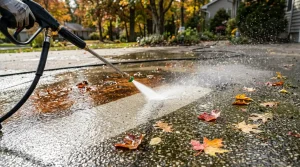
A pressure washer wand cleans a narrow path, and covering a driveway means overlapping those paths across the whole slab. When the wand moves at an inconsistent speed, or the passes do not overlap evenly, some areas get more cleaning than others. The result is bands of clean and less-clean concrete sitting side by side.
Skipping the Surface Cleaner
A flat surface cleaner is the attachment that keeps large concrete areas even. It holds the spray at a consistent distance and speed across its whole width, so the cleaning stays uniform. Cleaning a big driveway with just a wand, waving it back and forth, is where a lot of striping comes from. The tool is doing spot work on a job that needs even coverage.
Not Pre-Treating the Concrete
Concrete that gets a cleaning solution applied and given time to work comes up evenly, because the solution breaks down the grime across the whole surface before the pressure ever touches it. Skipping that step and relying on pressure alone means the wand has to do all the work, and any inconsistency in how it moves shows up as a stripe.
Inconsistent Pressure or Distance
Holding the wand closer to the concrete in some spots and farther in others changes how much cleaning each area gets. Same with pressure that fluctuates. Those differences print onto the slab as lighter and darker areas.
Why the Concrete Is Not Ruined
The relief in all of this is that striping is fixable, because it is a cleaning issue and not a material one.
The Fix Is More Cleaning, Not Less
Since the stripes come from uneven cleaning, the way to remove them is to even out the whole slab. Cleaning the entire surface consistently brings the darker areas up to match the lighter ones, and the pattern disappears. It takes redoing the job the right way, but the concrete itself does not need anything drastic.
It Is Not Etching
There is a worse problem that people sometimes confuse with striping, which is etching. Etching happens when too much pressure actually carves into the concrete surface and leaves permanent marks. Zebra striping is not that. The striping sits in the cleaning, not the concrete, so it comes out. Knowing the difference tells you if you are looking at a redo or at real damage.
How the Right Approach Prevents It
Avoiding stripes in the first place comes down to method and the right equipment.
Using a Surface Cleaner on Large Areas
A flat surface cleaner is the main defense against striping on driveways, patios, and walkways. It keeps the spray even across its full width and moves in overlapping passes, so the whole slab gets the same treatment. This is the difference between a driveway that comes up one even color and one that comes up striped.
Pre-Treating Before Pressure
Applying a cleaning solution and letting it dwell before running the surface cleaner means the grime is already broken down when the pressure hits it. That makes the cleaning far more even and takes the burden off the pressure to do everything, which is where inconsistency creeps in.
Working Methodically
Even coverage comes from steady, overlapping passes at a consistent speed and distance. It is slower than waving a wand around, and that pace is part of what keeps the result even. Rushing a driveway is one of the fastest ways to stripe it.
A Final Rinse Across the Whole Slab
Rinsing the entire surface evenly at the end clears any last inconsistency and helps the concrete dry to one uniform color. Skipping a thorough final rinse can leave faint lines even after a good cleaning.
Getting an Even Result
Zebra stripes are frustrating because the driveway is genuinely cleaner, yet it looks worse than before. The fix is straightforward, but it means doing the job with the right equipment and the patience to keep the coverage even, which is what avoids the problem from the start.
Our crew cleans concrete across Richmond, Midlothian, Glen Allen, Short Pump, and the surrounding areas using surface cleaners and pre-treatment that keep driveways, patios, and walkways an even color from edge to edge. If your concrete came out striped after a cleaning, or you want a driveway done right the first time, give us a call and we will take care of it.