
You put solar panels on your roof to save money, and for the first year or two the numbers look about like you expected. Then the production creeps down a little each season and you write it off as weather, or shorter days, or just the way it goes. A lot of the time the answer is sitting right on top of the panels. Dirt, pollen, and grime build up on the glass, and they cut into the light reaching the cells underneath.
Solar panel cleaning in Richmond, VA is not a chore most homeowners think about, but it matters more here than in a lot of other places. Virginia throws a specific set of conditions at rooftop panels, and they add up over the year.
How Dirt Cuts Into Your Production
Solar panels work by letting light reach the cells behind the glass. Anything sitting on that glass gets in the way.
Less Light Means Less Power
A film of dirt does not block light the way a cloud does, so nothing looks obviously wrong. It just shaves a little off, all day, every day. Studies across the industry put losses from soiling anywhere from a few percent on lightly dirty panels up to twenty percent or more on panels that have gone years without attention. On a system that was supposed to cover most of your power bill, that gap shows up on the statement.
Buildup Happens Gradually
Nobody notices soiling because it never happens overnight. The panels look about the same today as yesterday, and the production drop hides inside normal seasonal swings. That is what makes it easy to miss. By the time you can see the film from the ground, the panels have been underperforming for a long time.
Bird Droppings & Debris Hit Harder
An even layer of dust costs you a little across the whole panel. A bird dropping or a stuck leaf blocks one spot completely, and because of how panels are wired, one shaded cell can drag down the output of a whole section. Those spots do more damage than their size suggests.
What Virginia Weather Puts on Your Panels
The conditions here make soiling a real issue rather than a minor one.
Pollen Season Coats Everything
Central Virginia gets a long, heavy pollen season. Pine pollen alone leaves a yellow film on every flat surface for weeks, and your panels are flat surfaces pointed straight at the sky. That layer sits there through the sunniest part of spring, which is exactly when you want production at its best.
Tree Cover Means Leaves & Sap
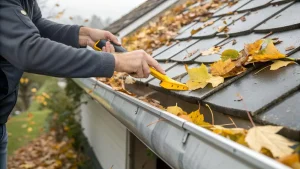
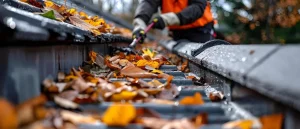
Richmond neighborhoods have a lot of mature trees, and that means leaf litter, twigs, and sap landing on roofs. Debris that catches along the bottom edge of a panel stays there, traps moisture, and gives grime something to hold onto.
Humidity Feeds Growth
Virginia summers are humid, and panels that stay damp collect more than dust. Algae and grime take hold along the frames and edges, and once organic growth starts, rinsing with a hose stops being enough to clear it.
Rain Does Not Do the Job
People assume rain washes the panels clean. It mostly does not. Rain lifts the loose dust, then dries and leaves mineral spots and a residue of whatever was already there. Light rain is worse than no rain, because it turns dust into a film that dries onto the glass.
Signs Your Panels Need Attention
You do not need special equipment to spot the problem.
The Numbers Are Slipping
Most systems come with monitoring, and that is the place to look. Compare this spring to the last one. If production has dropped and nothing else about the system has changed, soiling is a likely reason. A clear drop after pollen season points right at it.
You Can See It From the Ground
If you can make out a haze, a yellow cast, or streaks on the panels while standing in the yard, there is more up there than you can see from that distance. Panels that look dirty from below are usually well past due.
It Has Been Over a Year
If you have never had the panels cleaned and they have been up for more than a year, they have collected a season of pollen, a summer of humidity, and a fall of leaf litter. That is enough to cost you something on every bill.
Cleaning Panels the Right Way
Solar panels are glass over sensitive equipment, sitting on your roof and wired into your house. That calls for some care.
Pressure Is the Wrong Tool
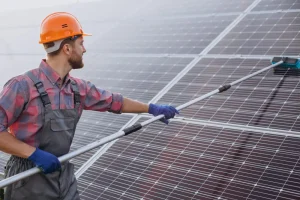
High pressure has no place on a solar panel. It can crack the glass, force water past the seals, and damage the frames and wiring connections. Panel cleaning is a low-pressure job that relies on the right solution and technique rather than force, along with water that will not leave mineral spots behind as it dries.
The Roof Is Part of the Problem
Cleaning panels means getting onto a roof, working around wiring, and moving carefully on a surface that is often wet in the process. That is a fall risk, and it is also a good way to damage panels or roofing if you are not sure what you are stepping on. It is worth handing off.
Keeping Your System Earning
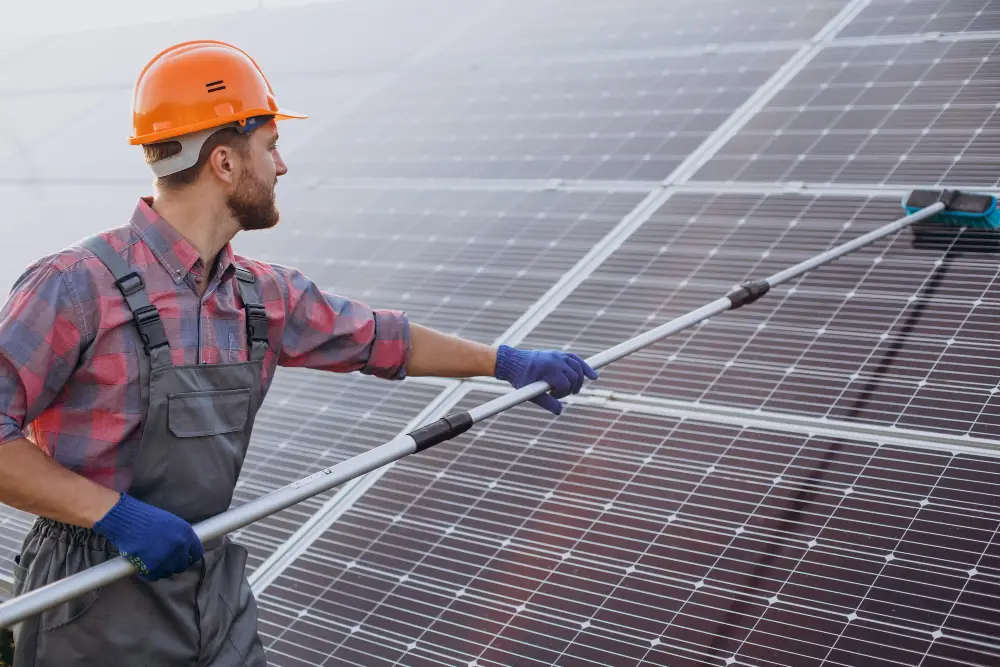
Our crew handles solar panel cleaning across Richmond, Midlothian, Glen Allen, Short Pump, and the surrounding areas. We use low-pressure methods and cleaning solutions that are safe for panel glass and seals, clear the debris that collects along the frames, and leave the surface free of the spots that a garden hose leaves behind.
Most systems around here do well with a cleaning once or twice a year. Late spring, after pollen season lets up, is the round that pays for itself the fastest, since it clears the panels going into the highest-production months of the year. Homes under heavy tree cover often benefit from a second visit in fall once the leaves have come down.
If your production numbers have been slipping, or your panels have never been cleaned since the day they went up, give us a call and we will take a look.